
Guest blog by April Rehrig, BCEA, LEP, PPS, CASDCS, the owner and founder of Rise Educational Advocacy and Consulting, LLC.
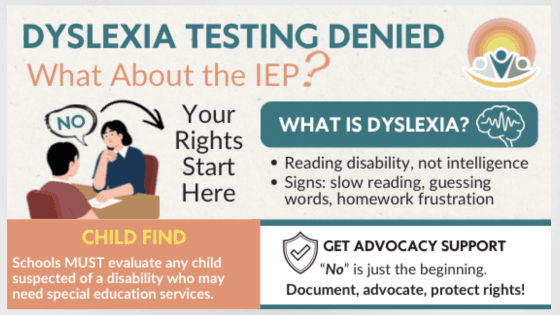
Your school said “no” to dyslexia testing.
Maybe they told you to “wait and see.” Maybe they claim they don’t test for dyslexia.
Now you’re wondering: Does this mean my child can’t get an IEP?
Here is the good news: A “no” does not end your child’s right to an IEP evaluation. It is simply the beginning of understanding your special education rights under the Individuals with Disabilities Education Act (IDEA).
Under IDEA, you have the right to request a comprehensive IEP evaluation when a disability is suspected — including dyslexia or a specific learning disability in reading.
Let’s walk through what you can do next.
Dyslexia is a reading disability. It affects how the brain connects letters and sounds. It has nothing to do with intelligence. Many bright children have dyslexia, including children with ADHD, autism, and other unique learning needs.
If your child reads slowly, struggles to sound out words, guesses instead of decoding, or becomes frustrated during homework, reading may feel much harder than it should. Asking for a special education assessment can provide answers. Early dyslexia testing and a comprehensive IEP evaluation can identify whether your child has a specific learning disability and qualifies for an IEP.
IDEA includes a rule called Child Find.
Child Find means public school districts must locate, identify, and evaluate all children suspected of having a disability.
“All” truly means all.
This responsibility applies even if your child attends private school, a charter school, or is homeschooled. The public school district where you live still has a duty to respond when a disability is suspected. Your child does not need to be enrolled in public school to request an evaluation.
Child Find does not require your child to be failing in order to be tested. Children can have passing grades or be enrolled in AP classes and still qualify for special education services.
If you want to make your request legally grounded, write that you are requesting an evaluation under IDEA’s Child Find obligation because you suspect a specific learning disability in reading. Always submit your Parent Request Letter and related communication in writing. Written requests document what you are asking for and require schools to respond.
Yes.
Public school districts are responsible for Child Find for all children who reside in the district. That includes students in private schools, charter schools, and homeschool programs.
If your child does not attend public school but you suspect dyslexia, you can still contact your local public school district and request an IEP evaluation. The bottom line: your district must respond.
Once your written request is received, a timeline begins. Schools can agree to evaluate or deny your request — but they cannot ignore you.
When they say “yes” or “no” to testing, schools must provide Prior Written Notice (PWN). This document explains why they are proposing or refusing to change an identification, evaluation, or placement decision. A verbal “no” is not PWN.
If testing is denied, respond in writing stating that you disagree and request Prior Written Notice, along with the records used to make that decision. When families request written explanations, schools often reconsider their position.
Many schools defer testing by saying they do not diagnose dyslexia. Others challenge the use of the word “dyslexia” in special education assessments.
Despite what they say, IDEA is clear: schools are obligated to evaluate your child for a suspected disability.
Dyslexia is classified as a Specific Learning Disability in reading. IDEA requires evaluation in all areas of suspected disability. This means that if reading is a concern, you have the right to request IEP testing.
To escalate your request, submit a Parent Letter of Attachment to the highest-ranking administrator in your district.
In your letter, clarify that you are requesting a special education assessment because you suspect your child has a disability. Identify the disability areas you suspect and any related service evaluations that may be necessary. Attach documentation such as private assessment results, medical diagnoses, or tutoring reports. Review your state’s department of education website to understand eligibility criteria and response timelines.
Ask for a formal meeting to review your request and expect Prior Written Notice.
No.
It is common for schools to tell families to “wait and see.” They may offer MTSS, tiered supports, or cite motivation, age, or “maturity.”
Intervention is a support tool, but it does not determine whether your child has a disability or qualifies for special education services.
Children do not have to be “below grade level” or failing before IEP testing can begin. Schools cannot use screeners or MTSS processes to defer or deny your right to request testing. A 504 Plan and interventions can occur while a child undergoes special education testing.
Sometimes schools complete IEP testing, and a child does not qualify for special education. This is not the end.
If you disagree, you have rights under IDEA.
You may request an Independent Educational Evaluation (IEE), which is testing conducted by a professional outside your school district. If you request an IEE at public expense, the district must either agree to fund it or initiate a legal process to defend its evaluation. They cannot ignore or delay your request.
Submit a written statement at the conclusion of the eligibility meeting indicating that you disagree with the district’s evaluation and are requesting an Independent Educational Evaluation at public expense.
If IEP testing is denied, put your disagreement in writing. Clearly state what you disagree with and how you want the matter resolved. Use terms such as “meaningful participation,” “suspected disability,” and “sufficiently comprehensive.”
Expect Prior Written Notice, Procedural Safeguards, or a meeting to resolve the issue.
Written documentation creates accountability, accelerates resolution, and strengthens your advocacy.
Yes.
IDEA requires public school districts to locate, identify, and evaluate all children suspected of having a disability — including students in public schools, private schools, charter schools, and homeschool settings.
You have the right to request testing.
You have the right to written explanations.
You have the right to request an Independent Educational Evaluation.
Sometimes, a well-written Parent Letter changes everything.
Remember: that “no” is just the beginning of your IEP journey.
Navigating the special education system is hard, especially when a school denies dyslexia testing or claims your child doesn’t qualify for services. When progress stalls or you are told to “wait and see,” it may be time to seek professional support to navigate the IEP evaluation process.
Rise Educational Advocacy empowers families with expert special education advocacy support, DIY IEP workshops, parent coaching, and practical guides designed for every level of experience. Whether a parent is preparing for an initial IEP testing request or looking to improve a 504 Plan, the organisation provides clear, step-by-step support to help families navigate the process with confidence.
April Rehrig, BCEA, LEP, PPS, CASDCS, is the owner and founder of Rise Educational Advocacy and Consulting, LLC.


©2026 Dyslexia On Demand. All Rights Reserved.