
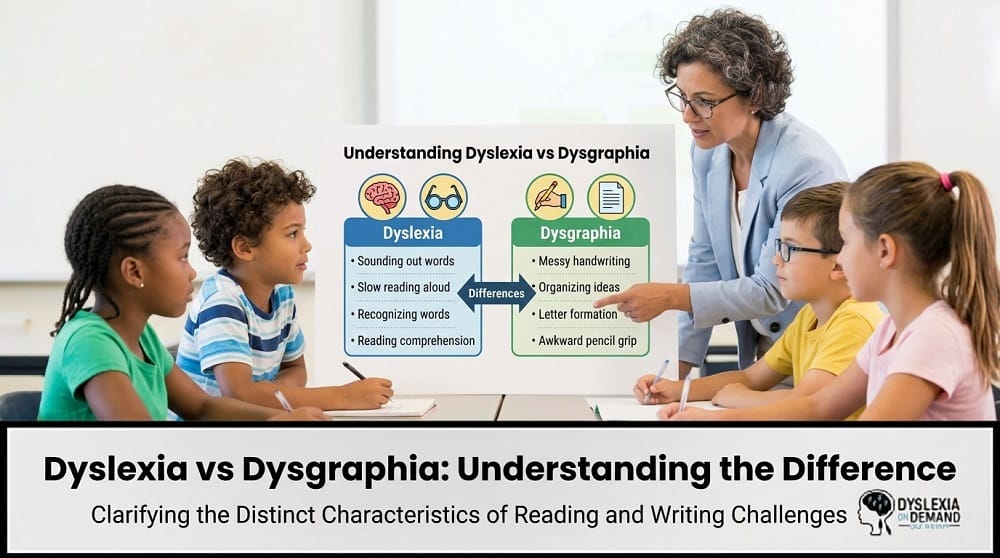
Dyslexia and dysgraphia are both specific learning differences, and they often appear together, but they affect different skills. Dyslexia primarily affects reading, while dysgraphia primarily affects writing. A child can have one, the other, or both, and telling them apart matters because each needs a different kind of support.
Because dyslexia is the more familiar term, dysgraphia is often overlooked or mistaken for messy handwriting or carelessness. Understanding what each one is, how they differ, and how they overlap helps parents get their child the right intervention rather than the wrong label.
Dysgraphia is a specific learning difference that affects a child’s ability to write. The word comes from the Greek: “graph” refers to producing letters by hand, and “dys” indicates impairment. It shows up in three main areas: handwriting and fine motor skills, spelling, and the executive functioning needed to organize thoughts into written language.
That last piece is the one parents miss most often. Dysgraphia is not only about how writing looks on the page. A child can have neat handwriting and still struggle to plan, sequence, and organize their ideas into coherent sentences and paragraphs. For many children, the physical act of writing takes so much effort that little mental energy is left for the content itself.
The International Dyslexia Association’s Understanding Dysgraphia fact sheet is a helpful, professionally reviewed overview for parents who want to go deeper.
Signs of dysgraphia can be hard to notice in younger children, but there are patterns worth watching for. Look for:
A useful clue is a gap between what a child can express out loud and what they can get onto paper. When a child has strong ideas but their writing does not show it, dysgraphia is worth considering.
Dyslexia affects both reading and spelling. It most outwardly affects the phonological awareness required for accurate word reading, and the very same decoding difficulty shows up in spelling, because reading a word and spelling a word are two sides of the same skill. There is evidence that the language centers of the brain work differently in people with dyslexia, which makes isolating and recognizing the individual sounds in words harder, whether the child is decoding a word to read it or building a word to spell it.
Children with dyslexia will often have some handwriting difficulty too, but dyslexia goes deeper than the mechanics of writing. The most visible challenge is with reading itself: decoding words, keeping the order of letters straight, and comprehension that suffers as a result. Because reading aloud is hard, many children with dyslexia become hesitant readers and struggle with fluency.
This is where the distinction gets important, and genuinely tricky. Dysgraphia affects written language, while dyslexia affects both reading and spelling. The two often appear together, but dysgraphia can stand alone, and formal testing can tease that apart. A child with dysgraphia alone may read fluently yet struggle to spell, and a norm-referenced assessment can show intact word-level reading and solid foundational phonological skills alongside a specific weakness in one or more components of writing.
It also works the other way, which is why professional testing matters so much. To an untrained eye, a child with dyslexia can appear to be reading fine when they are actually reading through memorization rather than true language processing. That is easy to miss at home and can only really be teased out in a formal, norm-referenced testing environment. So a parent should never assume that because a child seems to read well, the issue must be dysgraphia. Only proper assessment can tell.
Yes, and they frequently occur together. Dyslexia and dysgraphia can exist independently, but they often overlap, and both also commonly co-occur with ADHD and speech and language difficulties. When reading and writing are both affected, a child faces a double load at school, which can look like a motivation problem when it is really two distinct processing challenges stacked on top of each other.
This is exactly why an accurate evaluation matters. Two children who both “struggle with writing” may need very different support depending on whether the root is dysgraphia, dyslexia, or both. Our guide on what a full dyslexia evaluation involves explains how these overlapping profiles are assessed.
The best thing anyone can do when facing either difference is to seek multisensory intervention delivered by a Certified Academic Language Therapist. For dysgraphia treatment specifically, there are now strong options. A CALT can adapt instruction within the Take Flight curriculum to target the writing challenges of dysgraphia, and there is also a curriculum built specifically for dysgraphia, called Write Idea. So a child may be supported through Take Flight, adapted to their needs, or through Write Idea, depending on their profile.
Both approaches target the specific areas involved in dysgraphia: handwriting, explicit spelling instruction, and strategic writing planning and organization. A one-on-one therapist has the added advantage of tailoring activities prescriptively to a child’s most-needed areas, whether that means explicit instruction in letter formation, structured strategies for planning writing, or steady practice that builds both skill and confidence.
Neither difference is simply outgrown with age, so the earlier a child gets the right support, the better.
With proper identification, public schools must provide accommodations through a 504 Plan or an IEP to give the child a fair chance to work at their own pace and be thorough. Helpful dysgraphia accommodations include:
For a fuller picture of what to request and how support should change as your child grows, see our guides on choosing the right accommodations and accommodations by grade level.
You and your therapist can design coping strategies and tasks that help your child learn the way they are individually wired, and great teachers can partner with you on plans that support learning at home too. Diagnosis is never easy, but with work, understanding, and patience, confidence can be built and real progress made.
What is the main difference between dyslexia and dysgraphia?
Dyslexia affects both reading and spelling, while dysgraphia affects written language, including spelling and organizing thoughts on paper, but not reading. The two often occur together and can look similar from the outside, so only a testing professional can reliably tell which one a child has. A parent should not assume that a child who seems to read well simply has dysgraphia, because some children with dyslexia read through memorization rather than true decoding, which formal assessment is designed to uncover.
Can a child have dyslexia and dysgraphia at the same time?
Yes. The two often occur together, and both frequently co-occur with ADHD and speech or language difficulties. When both are present, reading and writing are affected at once, which is why targeted, individualized intervention works best.
Is dysgraphia just messy handwriting?
No. Messy handwriting can be one sign, but dysgraphia also affects spelling and the ability to organize and sequence ideas in writing. Some children with dysgraphia have neat handwriting yet still struggle to get their thoughts onto the page.
Can dysgraphia be outgrown?
No. Dysgraphia is not outgrown with age, though children can make significant progress with explicit instruction, the right accommodations, and consistent support. Early identification gives the best outcomes.
How is dysgraphia diagnosed?
Dysgraphia is identified through an evaluation that looks at handwriting, spelling, fine motor skills, and written expression, often alongside reading and language skills to check for co-occurring dyslexia. A thorough assessment is important so instruction can target every area affecting the child.
Does dysgraphia qualify a child for support at school?
Yes. When identified, dysgraphia can qualify a child for accommodations and services through a 504 Plan or an IEP. These can include assistive technology, extra time, reduced writing demands, and explicit instruction in handwriting and written expression.
Related reading: If your child’s challenges extend to numbers as well, our guides on why dyslexic students struggle with math and multisensory math support for dyslexia are a helpful next step.
Megan Pinchback, MBA, LDT, CALT is the founder and CEO of Dyslexia On Demand, a virtual dyslexia therapy practice serving students across the United States. As a Licensed Dyslexia Therapist and Certified Academic Language Therapist, she has spent her career helping children with dyslexia, dysgraphia, and related learning differences build the reading, writing, and language skills they need to become confident, independent learners. Megan is a national speaker, host of the Don’t Call On Me podcast, and a passionate advocate for helping families understand how these learning differences are identified and treated. Through Dyslexia On Demand, she leads a team made up entirely of Certified Academic Language Therapists who provide individualized, evidence-based intervention.

©2026 Dyslexia On Demand. All Rights Reserved.