
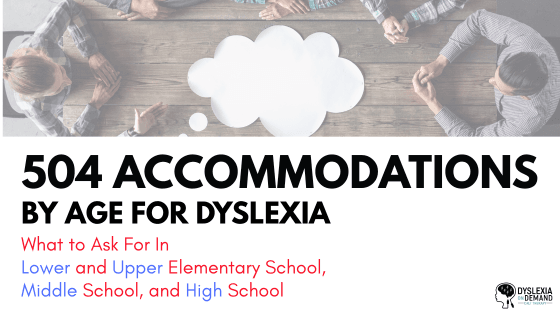
The best 504 accommodations for students with dyslexia change as children grow. A support that is essential in elementary school may no longer be necessary in high school, while older students often need accommodations that younger children do not. The most effective 504 Plan is one that evolves with a student’s changing academic demands, strengths, and level of independence.
When a child is first identified with dyslexia, one of the first questions parents ask is, “What accommodations should my child have?”
The answer is not as straightforward as many families hope.
A quick online search produces dozens of lists of 504 accommodations, making it seem as though every child with dyslexia should receive the exact same supports. In reality, nothing could be further from the truth.
One of the biggest misconceptions I see is the belief that accommodations should remain the same from kindergarten through high school. Just as children grow academically, socially, and emotionally, their accommodations should grow alongside them.
Before we discuss accommodations by age, I want to be transparent about my perspective.
I believe many students with dyslexia qualify for services through an Individualized Education Program (IEP). Dyslexia falls under the federal disability category of Specific Learning Disability, and many students need specialized reading instruction, not simply classroom accommodations. Unfortunately, many families find themselves navigating support through a 504 Plan instead.
The encouraging news is that the accommodations discussed in this article can generally be included in either a 504 Plan or an IEP. Whether your child receives support through Section 504 or the Individuals with Disabilities Education Act (IDEA), the goal remains the same: remove barriers created by dyslexia while ensuring your child continues to receive rigorous instruction and evidence-based intervention.
It is equally important to understand what accommodations are not.
Accommodations provide access.
They do not teach a child to read.
Only evidence-based structured literacy intervention addresses the underlying reading difficulties associated with dyslexia.
Before looking at accommodations by grade level, it helps to understand what 504 accommodations are and how to choose them. This article assumes you know the basics and want to know what to ask for at your child’s current stage.
Yes. A student’s 504 accommodations should change as academic expectations increase and executive functioning skills develop. Elementary, middle, and high school students face different learning demands, so their accommodations should reflect those changes.
Parents often assume that once a 504 Plan is written, it should stay the same until graduation.
In reality, an effective accommodation plan is a living document.
Young children need support learning foundational reading skills and developing independence. Older students face longer reading assignments, multiple teachers, increased writing demands, complex schedules, and greater responsibility for managing their own learning.
As those expectations grow, accommodations should be reviewed and adjusted to match the student’s current needs.
The goal is not to provide more accommodations each year.
The goal is to provide the right accommodations.

The primary goal during the early elementary years is to help children successfully access instruction as they learn foundational reading skills.
At this age, parents often ask their child which accommodations are helping, only to receive a shrug or a simple “I don’t know.”
That is completely normal.
Young children generally are not developmentally ready to evaluate which supports are most beneficial. Instead, your child’s classroom teacher becomes one of your greatest partners. Teachers observe your child every day across a range of activities and can often identify barriers that are difficult for parents to see at home.
Rather than asking for every possible accommodation, work collaboratively with your child’s teacher to determine which supports are making the biggest difference.
Some of the most effective accommodations during these early years include reading directions aloud before independent work begins. This reduces the decoding demands associated with understanding the task and allows students to focus on demonstrating what they know.
Reducing unnecessary copying from the board is another valuable accommodation. Young students with dyslexia often expend tremendous mental energy copying letters, words, and sentences. Providing guided notes, printed classroom materials, or teacher-created handouts allows students to devote that energy to learning instead.
Technology can also begin playing an important role. Programs such as Read&Write for Google Chrome provide text-to-speech, speech-to-text, vocabulary support, and study tools in a single platform. While younger students may initially need adult support using these features, introducing them early allows technology to become a natural learning tool as students grow.
For students whose listening comprehension is significantly stronger than their reading ability, Learning Ally or Bookshare may provide access to grade-level classroom content while they continue receiving structured literacy intervention.
When writing assignments are intended to assess ideas rather than spelling, teachers may also consider allowing oral responses or reducing penalties for spelling errors outside of formal spelling instruction.
Frequent teacher check-ins can also be extremely helpful. Young children often benefit from brief reminders, encouragement, and clarification before beginning independent work.
At this age, simple accommodations consistently implemented are usually far more effective than a lengthy list of supports that rarely get used.
Upper elementary school often represents one of the biggest transitions for students with dyslexia.
The curriculum shifts from primarily learning to read toward reading to learn. Students encounter longer chapters, more independent assignments, increased writing expectations, and standardized testing. Executive functioning also becomes increasingly important as students manage multiple assignments and greater personal responsibility.
As academic expectations grow, accommodations often need to evolve as well.
Read&Write for Google Chrome continues to be one of my favorite recommendations because students are beginning to use more of its advanced features independently. Learning Ally and Bookshare become increasingly valuable as classroom reading demands expand across multiple subjects.
Speech-to-text tools such as Google Voice Typing or Microsoft Dictate can help students express their ideas without allowing spelling and handwriting to become unnecessary barriers during first drafts and longer writing assignments.
Graphic organizers are especially useful because writing assignments require more organization and planning than in the primary grades.
Extended time and small-group testing may also become appropriate as reading demands increase.
One accommodation that is sometimes overlooked during these years is access to a multiplication chart or math facts chart.
It is important to understand that this accommodation is not appropriate simply because a student has dyslexia.
However, if recalling math facts has become an unnecessary barrier to demonstrating mathematical reasoning, a multiplication chart may allow teachers to assess students’ understanding of mathematical concepts rather than their memorization of basic facts.
As with any accommodation, the decision should be individualized to the student’s needs.
Perhaps the most important change that occurs during upper elementary school has nothing to do with technology or testing.
It has to do with your child finding their own voice.
Beginning around fifth grade, I strongly encourage families to invite their child to attend at least part of their annual 504 or IEP meeting.
They do not need to lead the meeting.
They do not need to understand every legal or educational discussion.
But they should begin hearing adults talk about their strengths, their challenges, and the supports that help them succeed.
Even if they answer only one question such as, “What helps you the most at school?” they are beginning to develop one of the most valuable lifelong skills they will ever learn.
Self-advocacy begins long before high school.
By the time students reach middle school, the goal of accommodations begins to shift.
While access to the curriculum remains critically important, there is now an equally important objective: helping students become independent learners and confident self-advocates.
Middle school brings multiple teachers, changing classrooms, larger workloads, long-term projects, and significantly greater expectations for organization. High school builds on those expectations while adding college entrance exams, career planning, extracurricular commitments, and increasing responsibility for managing one’s own education.
Because of these changes, accommodations should continue evolving.
Students often continue benefiting from comprehensive technology such as Read&Write for Google Chrome, particularly because they are now reading larger volumes of digital text and completing more complex writing assignments.
Learning Ally and Bookshare remain valuable for accessing novels, textbooks, and content-area reading without allowing decoding difficulties to limit learning.
Speech-to-text technology may become even more important as writing assignments become longer and more analytical. Students who once dictated only a few sentences may now be composing research papers, literary analyses, and essays that require considerably more written language.
Graphic organizers continue supporting planning, outlining, and organizing ideas before writing, while digital planning tools such as Google Calendar, Google Tasks, Microsoft To Do, or Todoist become increasingly valuable as students begin managing multiple classes, deadlines, and extracurricular activities independently.
Extended time and small-group testing often remain appropriate, particularly as assessments become more reading-intensive.
For some students, continued access to a multiplication chart or math facts chart may still be appropriate. Again, this accommodation should never be included simply because a student has dyslexia. Instead, it should be considered when automatic recall of math facts creates an unnecessary barrier to demonstrating mathematical reasoning or solving more advanced mathematical problems.
The focus should always remain on measuring the intended skill rather than allowing one area of weakness to interfere with another.
Families navigating school support alongside private therapy often find our guide to working with schools useful at this stage.
As students move through middle school and into high school, one of the greatest gifts we can give them is the ability to advocate for themselves.
Many parents naturally become the primary advocates during the elementary years, and rightfully so.
However, by middle school, students should gradually begin to take ownership of their dyslexia, recognize which accommodations help them, and communicate those needs respectfully to teachers.
This transition does not happen overnight.
It develops through small conversations and meaningful opportunities to participate.
Parents can encourage their child to help prepare for annual 504 or IEP meetings by asking questions such as:
“What accommodation helps you the most?”
“Is there anything on your plan that you rarely use?”
“What has become harder this year?”
“What do you wish your teachers understood about how you learn?”
These conversations teach students that accommodations are not something adults simply decide for them. They are tools that help remove barriers while allowing students to demonstrate their knowledge.
By the time students leave high school, they will be expected to advocate for themselves in college, technical programs, military training, or the workplace. Learning these skills during middle and high school prepares them for those future conversations.
One of the biggest mistakes I see is assuming that once accommodations are written into a 504 Plan or an IEP, they should simply remain there year after year.
That is rarely the best approach.
As students mature, some accommodations become less necessary as they develop stronger skills and greater independence.
Other accommodations become more important because academic expectations have changed.
Technology also continues evolving rapidly. Tools that were unavailable just a few years ago may now provide more efficient or more effective support than older accommodations.
Each annual meeting provides an opportunity to ask important questions.
Is my child actually using this accommodation?
Is it removing a meaningful barrier?
Has my child outgrown it?
Has a new challenge emerged that should be addressed?
Would a different support better meet my child’s current needs?
These conversations help ensure that accommodation plans remain practical, individualized, and relevant.
One of the biggest misconceptions surrounding 504 accommodations is that a longer list automatically creates better support.
In reality, the opposite is often true.
When accommodation plans become overloaded, teachers may struggle to consistently implement every support. Some accommodations may rarely be used, while others may no longer address the student’s greatest needs.
The strongest plans are thoughtful.
They are individualized.
They focus on removing the barriers that dyslexia creates for that particular student while encouraging increasing independence over time.
Remember, accommodations should never become permanent simply because they were helpful in second grade, nor should they be removed simply because a student has reached high school.
Every support should continue earning its place by serving a meaningful purpose.
Examples of 504 accommodations can provide an excellent starting point, but they should never become a checklist.
Every student with dyslexia has a unique learning profile.
Some students primarily need reading supports.
Others struggle more with written expression, executive functioning, or organization.
Still others require only a few carefully selected accommodations because high-quality dyslexia intervention has significantly reduced many of their barriers over time.
The goal has never been to ask for every possible accommodation.
The goal is to identify the right accommodations at the right time.
Whether your child receives support through a 504 Plan or an IEP, those accommodations should always work alongside evidence-based structured literacy instruction, not replace it.
Accommodations provide access.
Intervention builds skill.
When those two pieces work together, students develop not only stronger reading abilities but also the confidence, independence, and self-advocacy skills they will carry into adulthood.
That is ultimately what every accommodation plan should be designed to accomplish.
At what age should my child attend their own 504 meeting?
Around fifth grade is a reasonable starting point for attending part of the meeting. Students do not need to lead it, but hearing adults discuss their strengths and supports builds the self-advocacy skills they will need later.
Should accommodations be removed once my child’s reading improves?
Usually not. Reading can improve significantly, but dyslexia is a lifelong difference in how the brain processes language, and the underlying gap is rarely closed completely. Stronger reading scores do not always mean a student can manage the reading load of a demanding class without support. In most cases it is wiser to keep accommodations in place and review whether each one is still doing useful work, rather than removing supports because a test result looks better.
Do 504 accommodations carry over to college?
No. College accommodations require a separate application through the disability services office, and documentation requirements are usually stricter. A recent evaluation and a history of accommodations at school both help.
My child says they do not want accommodations anymore. What should I do?
This is common in middle school and usually about visibility rather than usefulness. Ask which specific supports feel uncomfortable and why, since many can be delivered more discreetly rather than dropped entirely.
How often should a 504 Plan be reviewed?
At least annually. Request an earlier meeting if your child moves to a new school, struggles with a new subject, or stops using accommodations that were previously helping.
U.S. Department of Education Office for Civil Rights. Protecting Students with Disabilities: Frequently Asked Questions About Section 504 and the Education of Children with Disabilities.
Office of Special Education Programs. A Guide to the Individualized Education Program (IEP). U.S. Department of Education.
National Center for Learning Disabilities. The State of Learning Disabilities and Understanding 504 Plans.
CAST. Universal Design for Learning Guidelines 3.0.
National Center on Accessible Educational Materials for Learning. Accessible Educational Materials and Assistive Technology.
National Center on Improving Literacy. Dyslexia Toolkit and Family Resources.
Council for Exceptional Children. High-Leverage Practices for Students with Disabilities.
Learning Disabilities Association of America. Accommodations and Supports for Students with Learning Disabilities.
International Dyslexia Association. Dyslexia in the Classroom: What Every Teacher Should Know.
Texas Education Agency. The Dyslexia Handbook: Procedures Concerning Dyslexia and Related Disorders.
Megan Pinchback is the founder of Dyslexia On Demand, a virtual dyslexia therapy company serving students worldwide. She is a Certified Academic Language Therapist (CALT), dyslexia advocate, national speaker, podcaster, and social media educator dedicated to helping families better understand dyslexia, structured literacy, advocacy, and the social-emotional impact of learning differences. Through Dyslexia On Demand, she has helped thousands of families navigate dyslexia with individualized intervention, parent education, and advocacy. Megan is also a mother of five and grandmother to one living outside of Austin, Texas.

©2026 Dyslexia On Demand. All Rights Reserved.