
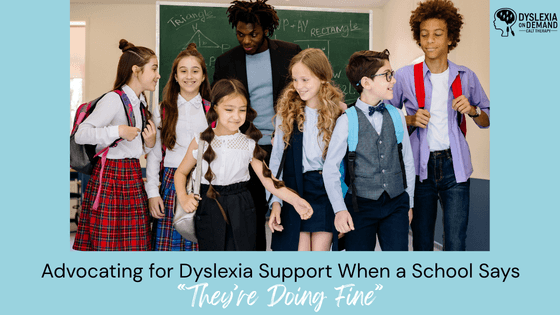
One of the most confusing moments for families comes when a child is clearly struggling at home, but the school reports, “They’re doing fine.”
They’re passing.
They’re meeting grade-level expectations.
They’re not failing.
And yet… reading takes hours. Writing is exhausting. Confidence is slipping.
For students with dyslexia, “fine” is often a reflection of survival, not success.
Understanding this gap is the first step toward meaningful dyslexia advocacy and accessing the right dyslexia support.
Schools are typically measuring performance through a general education lens. That includes:
But these measures don’t always capture underlying reading difficulties, especially in students who are:
A child can appear “on track” while still having a significant reading disorder. They are appearing to stay afloat all while their brains aren’t processing language efficiently. The cost is extra work, exhaustion, and constant sources of comparison to those around them, questioning “why is this so easy for everyone else? Am I dumb?”
This is why dyslexia screening, dyslexia evaluation, and deeper dyslexia assessment matter—they look beyond surface-level performance.
When a child with dyslexia is labeled as “fine,” several things often happen:
Gaps Continue to Grow
Without explicit, systematic instruction, foundational reading skills remain weak. Over time, this impacts dyslexia reading development, spelling, and writing skills.
Effort Masks Need
These students often work harder than their peers just to maintain average performance. This can lead to fatigue, avoidance, and increased anxiety.
Confidence Takes a Hit
Students begin to internalize the struggle:
“If I’m doing fine, why does this feel so hard?”
This is where the social-emotional component of dyslexia becomes just as critical as academic support.
Public schools are required to provide support when a disability impacts a child’s ability to access their education.
However, eligibility is not based on effort or frustration, it’s based on measurable impact.
A student may be passing classes, scoring within low-average ranges, and still not qualify under strict criteria… while clearly needing intervention.
This is why parents often need to advocate for a formal dyslexia identification, a comprehensive dyslexia evaluation, and data that reflects true skill gaps—not just classroom performance.
For a helpful overview of parent rights under federal law, visit: IDEA website.
Ask for Specific Data
Shift the conversation from general impressions to measurable skills. “Fine” is not a data point. Use these specific questions to move the discussion toward objective performance:
Questions to Ask During School Meetings:
Request a Formal Evaluation
If concerns persist, you can request a school-based evaluation in writing.
This may include dyslexia screening, a full dyslexia assessment, and evaluation for dyslexia and dysgraphia.
If the school declines, they are required to provide written notice explaining why.
You also have the right to pursue an independent educational evaluation.
Understand What Quality Intervention Looks Like
Not all reading support is equal.
Effective dyslexia therapies should include explicit, systematic instruction, a structured literacy approach, cumulative and data-driven teaching, and frequent progress monitoring.
Programs labeled as Orton-Gillingham can vary widely in quality depending on the provider’s training.
This is where online dyslexia tutoring with highly trained therapists can be a critical supplement—or primary support.
Put Accommodations in Writing
Even if a child does not qualify for specialized instruction, they may still benefit from support through a 504 plan.
Examples include:
Clear, specific language matters. Vague phrases like “as needed” often result in inconsistent support.
Trust What You’re Seeing at Home
Parents are often the first to notice when something isn’t adding up.
If homework takes significantly longer than expected, if reading is avoided, or if your child is showing signs of frustration, those are valid data points.
You don’t need to wait for failure to take action.
If progress is slow or stagnant, it may be time to look beyond the school setting.
High-quality dyslexia tutoring or dyslexia help for students can close foundational skill gaps, build reading fluency through accuracy, strengthen writing and spelling, and support long-term independence.
This is especially important for students with more complex profiles, including math dyslexia, coexisting ADHD or executive functioning challenges, and older students or dyslexia in adults who were missed earlier.
“Fine” should not mean barely keeping up, working twice as hard, avoiding reading, or feeling defeated.
True progress looks like measurable growth in reading and spelling scores, increased independence, improved confidence, and reduced effort for the same tasks.
In overcoming dyslexia, the goal is not just to pass, it’s to thrive.
Advocating for a child with dyslexia can feel overwhelming, especially when concerns are minimized.
But clarity comes with the right questions, the right data, and the right support.
You are not asking for something extra.
You are asking for what your child needs to access their education fully.
And that is always worth advocating for.
International Dyslexia Association. Dyslexia Basics [1]
U.S. Department of Education. Individuals with Disabilities Education Act (IDEA) [2]
Shaywitz, S. Overcoming Dyslexia (2nd ed.) Overcoming Dyslexia
National Center on Improving Literacy. Structured Literacy [3]



©2026 Dyslexia On Demand. All Rights Reserved.