
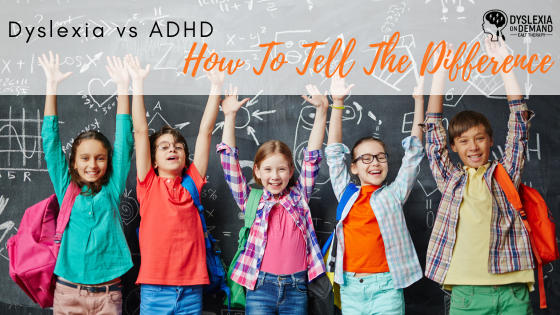
Is this dyslexia or something else, like ADHD?
This is one of the most common questions parents quietly carry, often for years. A child is struggling with reading, school feels hard, and homework is exhausting. Somewhere along the way, a label enters the conversation: ADHD. Sometimes that label fits and explains part of the picture. Other times, it completely misses what is really going on.
Understanding the difference between dyslexia vs adhd, and recognizing how often they overlap as comorbid conditions, can change the entire trajectory of a child’s learning journey.
When a child faces persistent difficulties in school, it is completely natural for parents to feel overwhelmed by the conflicting signs. The goal of identifying these challenges isn’t simply to label your child. Instead, it is to understand exactly why reading, focus, or language processing feels so hard, allowing you to discover the specific support that will actually help them thrive.
While they are frequently discussed together, adhd and dyslexia are entirely separate neurological profiles that affect different systems in the brain. ADHD is fundamentally a deficit in attention, executive control, and impulsivity. Dyslexia, on the other hand, is neurobiological in nature and represents a specific deficit in language processing, primarily impacting decoding, spelling, and reading accuracy.
A child with ADHD struggles with regulation, meaning their difficulties with focus and organization show up across all environments, from the classroom to completing daily chores at home. For a child with dyslexia, the challenge is highly situational, occurring when they are asked to process written language. Even when a dyslexic child is deeply focused, motivated, and doing their absolute best, their underlying decoding difficulties remain.
To help clarify how these two distinct conditions impact a student, it is helpful to look at how their core traits manifest:
| Feature | ADHD | Dyslexia |
| Primary Deficit Area | Attention, executive functioning, impulse control, and regulation. | Language processing, word decoding, spelling, and written expression. |
| Environmental Impact | Present across all unstimulating environments, affecting school, homework, and home chores. | Primarily triggered by reading, writing, and print-heavy language demands. |
| Task Performance | Inconsistent effort across tasks, but the child can often hyper-focus on activities they enjoy. | Avoids reading and writing tasks, but can maintain sustained focus on non-print activities like building or audiobooks. |
| Impact of Focus | Performance often improves in the moment when the child is slowed down, prompted, or given reminders. | Underlying decoding errors and phonological difficulties persist even when the child is highly focused. |
Understanding this baseline difference is the first step toward choosing the right support for your child. You can have one condition, or you can have both, but they require very different approaches to intervention.
When reading difficulties show up in the classroom, it can be easy to mistake one condition for the other. However, a closer look at the exact mechanics of how a child reads reveals very different underlying causes.
According to the International Dyslexia Association, both dyslexia and ADHD can cause students to become dysfluent readers who miss parts of what they are reading, feel tired or frustrated, and occasionally act out to avoid text. But the types of mistakes they make are completely different.
When reading difficulties are primarily driven by ADHD, the foundational reading skills are often present, but executive regulation and consistency are missing. An ADHD reader typically acts out of impulsivity or a lack of sustained attention.
For a child with dyslexia, reading errors are not a result of carelessness or rushing. The breakdown happens because the brain struggles to automatically break words down into phonological segments and connect letters to their corresponding sounds.
Here is where things get complicated for many families. Many children do not have just one or the other; instead, they experience both dyslexia and ADHD simultaneously. In the world of clinical psychology and education, this is known as comorbidity, which simply means two distinct conditions appearing in the same person.
Statistically, these two conditions go hand in hand. According to data from the Centers for Disease Control and Prevention (CDC), between 50% and 60% of people with ADHD also have a co-occurring learning disability, with dyslexia being the most common. Looking at it from the other side, the International Dyslexia Association notes that an estimated 40% of students with dyslexia also have a comorbid form of attention deficit disorder. Research elsewhere commonly cites general comorbidity overlap rates around 30%, but in clinical practice, the overlap often appears much higher because the children struggling most intensely are the ones seeking in-depth intervention.
When dyslexia and ADHD show up together, their symptoms overlap and mask one another, creating a complex puzzle for parents and teachers:
Because they influence and mask each other, it is incredibly easy for schools to mistake dyslexic symptoms for ADHD alone. This is a primary reason why many families get stuck with an incomplete picture, making it vital to look closely at the early signs of dyslexia before assuming it is an attention issue alone.
Because the symptoms of dyslexia and ADHD frequently run together, persistent reading difficulties deserve a closer look through formal evaluations. Sadly, it is not uncommon for parents to hear from school administrators that they will not test a child for dyslexia until their attention issues are controlled first.
This explanation is inaccurate and should not be accepted by parents. ADHD does not cause consistent decoding errors, poor phonological processing, or an inability to retain spelling patterns. Delaying a language evaluation under the guise of “controlling attention” only causes children to lose critical years of early intervention.
When navigating school appraisals, keep these advocacy points in mind:
A comprehensive psychoeducational or neuropsychological evaluation is the most reliable way to determine if a reading difficulty is rooted in attention, language processing, or a combination of both.
Focusing solely on the scholastic challenges of dyslexia and ADHD makes it easy to overlook the unique cognitive advantages that often come with this specific neurodivergent profile. The term “disorder” frequently fails to capture the immense strengths of a brain that processes information differently.
When a child learns to navigate the specific pitfalls of both conditions, their unique cognitive gifts can fully express themselves. Many individuals who possess both dyslexia and ADHD demonstrate remarkable intellectual capability and high levels of creative resilience.
Key strengths frequently observed in children and adults with this dual-diagnosis profile include:
Recognizing these qualities helps reframe the conversation for parents. These minds are not broken; they simply process the world through a different lens. With the right targeted support to address the literacy barriers, these innate gifts can become their greatest assets.
Helping a child with both dyslexia and ADHD to succeed requires addressing both conditions equally. It is fully possible to dramatically improve a child’s reading and focus, but lasting progress can only occur if you treat each condition according to its specific neurological root. Applying an attention strategy will not fix a reading deficit, and a reading strategy will not regulate executive functioning.
Students with ADHD generally respond well to behavioral management and environmental structures that accommodate their regulation needs. Effective strategies include:
While accommodations like extra time or audiobooks help with classroom access, they do not cure the underlying decoding deficits caused by dyslexia. Dyslexia strictly requires an evidence-based, systematic, explicit, and multisensory therapeutic approach.
To achieve measurable progress, reading intervention must be structured literacy program based on the Orton-Gillingham methodology, such as Take Flight or Basic Language Skills. Furthermore, these programs need to be delivered exclusively by a Certified Academic Language Therapist (CALT).
Every child deserves the opportunity to grow into an independent, confident, and responsible advocate for their own learning success. When you address the attention challenges while simultaneously deploying targeted language therapy, you give your child the precise tools they need to live up to their true academic potential.
Yes, many children have dyslexia without any attention difficulties. Their reading and spelling struggles are consistent and patterned, showing up clearly even when focus, attention span, and classroom behavior are exceptionally strong.
No, ADHD does not cause dyslexia, and dyslexia does not cause ADHD. They are entirely separate neurological conditions with different underlying causes. However, because they frequently co-occur, having ADHD can make a child’s underlying dyslexia much harder to recognize, untangle, and manage without professional help.
A child whose difficulties stem primarily from ADHD will make random, inconsistent reading errors due to impulsivity, rushing, or inattention; they often improve when slowed down or given focus prompts. A child with dyslexia struggles with phonological processing and word decoding, making patterned errors that persist even when the child is completely calm, highly focused, and taking their time.
Classroom accommodations like extra time, preferred seating, or read-aloud support are excellent for providing access to curriculum and assisting with focus. However, they do not provide remediation. They do not address or correct the underlying phonological processing and decoding deficits caused by dyslexia.
Yes, virtual dyslexia therapy can be highly effective for children with this dual diagnosis when it is structured, individualized, and delivered by a trained specialist. Highly interactive sessions with intentional pacing, frequent engagement, and built-in executive functioning supports allow neurodivergent students to make strong, measurable progress through a structured online dyslexia therapy environment.
If you are wondering whether your child’s struggles are dyslexia, ADHD, or a combination of both, trust that instinct. Confusion and mixed messages from school academic reviews are incredibly common, and the co-occurrence of these conditions is much more frequent than most people realize.
Obtaining true diagnostic clarity changes everything. Understanding exactly why reading or focus is hard allows your family to pursue targeted support that actually addresses the root cause, rather than relying on explanations that feel convenient. You do not need to have all the answers today; you just need permission to ask better questions.
That is exactly where advocacy begins. At Dyslexia on Demand, we are dedicated to making high-quality dyslexia therapy accessible to students who need it, helping to change lives and improve self-confidence through specialized instruction.
If you are ready to learn more or need guidance on the next steps for your child, please reach out to us or schedule a free consultation on our website today.
American Psychiatric Association. (2013). Diagnostic and statistical manual of mental disorders (5th ed.).
International Dyslexia Association. (2023). Dyslexia basics. https://dyslexiaida.org
Shaywitz, S. (2003). Overcoming dyslexia: A new and complete science-based program for reading problems at any level. Alfred A. Knopf.
International Dyslexia Association. (2024). Dyslexia basics. https://dyslexiaida.org/dyslexia-basics/
Pennington, B. F. (2006). From single to multiple deficit models of developmental disorders. Cognition, 101(2), 385–413. https://doi.org/10.1016/j.cognition.2006.04.008
Snowling, M. J., Hulme, C., & Nation, K. (2020). Defining and understanding dyslexia: Past, present and future. Oxford Review of Education, 46(4), 501–513. https://doi.org/10.1080/03054985.2020.1765756
Willcutt, E. G., et al. (2010). Prevalence and neurodevelopmental correlates of ADHD–dyslexia comorbidity. Journal of Learning Disabilities, 43(6), 540–560. https://doi.org/10.1177/0022219410374236


©2026 Dyslexia On Demand. All Rights Reserved.