
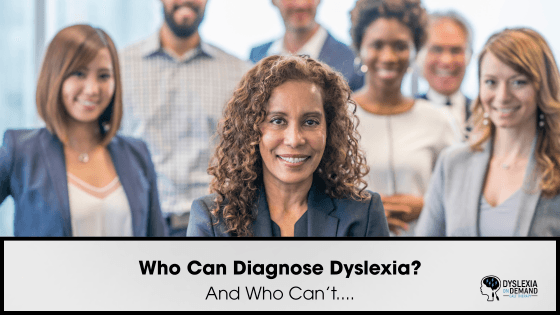
One of the most confusing parts of the dyslexia journey is figuring out who can actually diagnose dyslexia. Parents hear different answers from schools, pediatricians, therapists, tutors, and even the internet. Some are told schools cannot diagnose dyslexia. Others are told only a medical doctor can do it. Some families are encouraged to pursue expensive private testing without understanding what type of evaluation they actually need.
The truth is more nuanced than most people realize.
There are several professionals who may be qualified to identify or diagnose dyslexia, both inside and outside of the school system. But the biggest issue is not simply whether someone technically can diagnose dyslexia. The real question is whether they truly understand dyslexia and know how to identify it accurately, especially when ADHD, giftedness, anxiety, language disorders, or twice exceptionality are also part of the picture.
Because dyslexia rarely exists in isolation.
A dyslexia diagnosis identifies a pattern of reading and language weaknesses consistent with dyslexia. Dyslexia is a neurobiological learning disability that primarily impacts word recognition, decoding, spelling, and reading fluency. It is not related to intelligence.
A good dyslexia diagnosis looks beyond whether a child is simply “behind” in reading. It examines why reading is difficult. This is important because many bright children compensate for years before anyone realizes how hard they are working underneath the surface.
This is why understanding dyslexia requires much more than looking at grades or benchmark scores.
Yes. Schools can diagnose dyslexia, although they use the term ‘identify dyslexia’.
This surprises many parents because they are often told otherwise.
The confusion comes from the fact that schools do not typically use medical language. Schools identify disabilities under educational law, specifically the Individuals with Disabilities Education Act (IDEA). Dyslexia falls under the category of Specific Learning Disability.
However, the U.S. Department of Education has repeatedly clarified that schools are allowed to use the term dyslexia in evaluations, eligibility paperwork, and IEP documents.
In a 2015 Dear Colleague Letter, the Office of Special Education Programs (OSEP) explicitly encouraged schools to use the terms dyslexia, dyscalculia, and dysgraphia when appropriate. The letter explained that there is nothing in IDEA that prohibits schools from using these terms. (ed.gov)
So when families hear, “Schools cannot diagnose dyslexia,” that is not entirely accurate.
Schools absolutely can identify dyslexia when evaluation data supports it.
Several school based professionals may participate in identifying dyslexia.
A school psychologist may conduct cognitive and academic testing to determine whether a child has a Specific Learning Disability consistent with dyslexia.
A strong school psychologist who truly understands dyslexia can be incredibly valuable.
However, not all school psychologists receive extensive training in dyslexia specific assessment. This is where parents need to ask thoughtful questions:
Those questions matter.
In some states, including Texas, educational diagnosticians often conduct evaluations related to learning disabilities.
Again, training and experience matter tremendously. Two evaluators can technically hold the same credential while having vastly different levels of understanding about dyslexia profiles.
Many parents ask, “Can SLPs diagnose dyslexia?”
The answer depends partly on state regulations and professional scope, but many Speech Language Pathologists are highly knowledgeable about language based learning disorders and may play an important role in identification and assessment.
SLPs are especially valuable when children have overlapping language weaknesses, phonological processing difficulties, expressive language concerns, or speech sound disorders alongside dyslexia.
That said, not every SLP specializes in literacy or dyslexia. Parents should look for someone with specific experience in language based reading disorders.
Even when school professionals identify dyslexia, translating that information into classroom support can be a complex process. School screening tools do not always fully capture underlying language challenges like phonological awareness or rapid naming. This can result in generic interventions that lack the intensity or specificity of a structured literacy approach grounded in the science of reading. For families navigating this transition, working alongside an educational advocate can help bridge the communication gap between parents and school administrators to secure specific, measurable accommodations.
A pediatrician may recognize signs of dyslexia and refer for evaluation, but most pediatricians do not conduct comprehensive dyslexia testing themselves.
Pediatricians are often the first professionals parents mention concerns to, especially when reading struggles overlap with attention issues, anxiety, or school avoidance.
A pediatrician may help rule out medical issues, vision concerns, hearing problems, sleep disorders, or developmental concerns. They may also identify ADHD, which commonly coexists with dyslexia.
But a standard pediatric visit is generally not enough for a comprehensive dyslexia diagnosis.
This is another area that causes confusion.
Dyslexia is recognized as a neurobiological learning disability. However, dyslexia identification often happens through educational evaluations rather than medical diagnosis.
A child does not need a medical diagnosis from a physician to qualify for school based services or intervention.
Schools evaluate educational impact. Medical providers evaluate medical conditions. There can be overlap, but they are not the same process.
Families may also pursue private dyslexia testing outside of the school system.
This is often done when:
If you find yourself in any of these situations, our comprehensive guide on how to get your child tested for dyslexia walks you through the specific steps of the evaluation process and what to expect from a private provider.
Neuropsychologists often conduct the most comprehensive evaluations.
These evaluations may assess:
This type of evaluation can provide a full cognitive profile, not just a straight dyslexia determination.
That distinction matters.
A simple dyslexia diagnosis may tell you that dyslexia exists.
A comprehensive neuropsychological evaluation may explain how the child learns overall, what other conditions coexist, what strengths can be leveraged, and what interventions are most appropriate.
This can be especially important for twice exceptional students.
Twice exceptional children are both gifted and disabled.
These students are frequently missed.
A highly intelligent child may compensate so well that schools do not recognize the reading disability for years. They may score average overall despite enormous effort, exhaustion, anxiety, or avoidance.
Some twice exceptional students are mislabeled as lazy, inattentive, unmotivated, or behavioral because their intelligence masks their struggle.
Others have ADHD alongside dyslexia, which can complicate identification even further.
ADHD and dyslexia commonly coexist, but they are different conditions.
ADHD primarily affects attention, executive functioning, regulation, and focus.
Dyslexia primarily affects word level reading, decoding, spelling, and phonological processing.
A child can absolutely have both.
Unfortunately, some evaluators stop at ADHD and never fully assess reading processes. Others focus only on reading scores and miss attention or executive functioning concerns.
This is why evaluator expertise matters so much.
The best evaluators understand overlapping profiles and know how to separate compensation from true skill mastery.
Yes. Adults can absolutely receive a dyslexia diagnosis.
Many adults were never identified as children, especially older adults who attended school before dyslexia awareness became more widespread.
Adults may seek evaluation because they struggle with:
Many adults describe finally understanding themselves after diagnosis. What they once thought was laziness, lack of intelligence, or failure suddenly makes sense through the lens of dyslexia.
Many adults and parents strongly suspect dyslexia before formal testing ever occurs.
Self recognition can be meaningful and validating. Online dyslexia screeners and checklists may help identify risk factors or common traits.
However, self diagnosis is not the same as a comprehensive evaluation.
Formal testing helps determine whether dyslexia is present, identifies other possible conditions, and guides intervention recommendations.
Online dyslexia tests can be a useful starting point, but they should not replace a full assessment when significant concerns exist.
Parents often ask how early can you diagnose dyslexia.
Risk factors can appear very early, especially with strong family history. Difficulties with rhyming, phonemic awareness, letter sound learning, rapid naming, and early decoding may emerge in preschool and kindergarten.
Many professionals feel more confident making a formal dyslexia diagnosis once a child has had exposure to reading instruction, typically in early elementary school. The general standard for many is when the student turns 7 or is mid-firect grade, whichever comes first.
The key is not waiting for severe failure.
Early identification allows earlier intervention, which can dramatically improve outcomes.
When searching for someone who can diagnose dyslexia in a child, the credential matters less than the expertise.
Parents should ask:
A credential alone does not guarantee dyslexia expertise.
There is no single “perfect” path to a dyslexia diagnosis.
Schools can diagnose dyslexia.
Private evaluators can diagnose dyslexia.
Neuropsychologists can provide deeper cognitive insight.
SLPs may identify important language related factors.
Pediatricians may recognize warning signs and make referrals.
The most important piece is finding someone who genuinely understands dyslexia and can identify it accurately, even when giftedness, ADHD, anxiety, or compensation strategies make the profile more complex.
A diagnosis should not just answer whether dyslexia exists.
It should help explain how the child learns, why they struggle, what strengths they possess, and what support will help them move forward with confidence.
Once you receive formal confirmation, understanding what to do after a dyslexia diagnosis is the next step toward securing effective classroom accommodations.
U.S. Department of Education Office of Special Education Programs. Dear Colleague Letter on Dyslexia. (ed.gov)
International Dyslexia Association. Dyslexia Assessment: What Is It and How Can It Help? (dyslexiaida.org)
International Dyslexia Association. Testing and Evaluation. (dyslexiaida.org)
International Dyslexia Association. Dyslexia in the Classroom: What Every Teacher Needs to Know. (dyslexiaida.org)
Understood. ADHD and Dyslexia: What You Need to Know. (understood.org)
Yale Center for Dyslexia & Creativity. Signs of Dyslexia. (dyslexia.yale.edu)
Megan Pinchback is the founder and owner of Dyslexia on Demand and a Certified Academic Language Therapist (CALT). She is also the co-host of the Don’t Call on Me Podcast, a national speaker on dyslexia, social media educator and advocate, mom of five, and grandma to one. Through her work, she is passionate about helping families better understand dyslexia, access evidence-based support, and feel less alone in the journey.

©2026 Dyslexia On Demand. All Rights Reserved.