
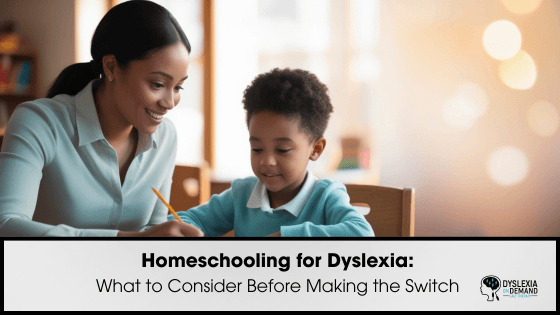
If you’re considering homeschooling for dyslexia, chances are you’ve reached a point where something isn’t working. Maybe your child is overwhelmed, frustrated, or starting to lose confidence. Maybe you’re watching them work twice as hard as their peers just to keep up.
For many families, homeschooling becomes a way to step out of that daily pressure and create something better. The ability to slow things down, reduce stress, and meet your child where they are can feel like a much-needed reset.
And for the right family, homeschooling can be an incredibly positive and effective option.
But before making the switch, it’s important to take a clear, balanced look at what homeschooling can offer, and how to set it up in a way that truly supports your child.
Homeschooling with dyslexia can be a powerful option for the right child and the right family. One of the biggest benefits is flexibility.
At home, you can adjust the pace. You can spend more time on reading without the pressure of keeping up with a classroom timeline. You can build in breaks, reduce overload, and create a calmer learning environment.
For many children with dyslexia, this shift alone can be transformative. When the daily cycle of frustration is removed, confidence often begins to rebuild. Children who once avoided schoolwork may become more willing to engage when the environment feels safe and manageable.
Homeschooling also allows you to tailor instruction more closely to your child’s needs. You can focus on progress instead of comparison, and you can adjust expectations in a way that supports growth without constant overwhelm.
At the same time, it’s important to recognize that homeschooling is not simply a change in location but a change in responsibility. You are stepping into a more active role in your child’s education, which can feel both empowering and, at times, challenging.
One of the most important decisions you’ll make is choosing the best homeschool curriculum for dyslexia.
There are some strong, accessible options available to parents. Programs like Logic of English and Barton are both well-respected, structured literacy-based approaches that many families successfully use at home. They are comprehensive and designed to walk you step-by-step through instruction, which can be incredibly helpful.
However, even with a strong curriculum, implementation matters just as much as the program itself.
Children with dyslexia do not all learn at the same pace or in the same way. Progress often requires more repetition, more review, and more intentional pacing than a lesson manual might suggest. It is rarely as simple as moving to the next lesson because the book says to.
This is where many parents start to feel unsure. Not because they chose the wrong curriculum, but because dyslexia requires constant adjustment.
It’s important to give yourself permission to slow down, revisit concepts, and prioritize mastery over completion. That flexibility is actually one of the greatest strengths of homeschooling.
At the same time, if you’ve been consistently implementing a program for several months and are not seeing meaningful progress, that’s important information. In those cases, bringing in a professional can help you better understand what adjustments are needed and ensure your child is moving forward.
Homeschooling a child with dyslexia can absolutely improve your child’s daily experience.
It can reduce stress, allow for a more flexible schedule, and create space for individualized attention. It can help your child feel less like they are constantly struggling to keep up, and more like they are capable of learning.
Those shifts matter. They often lay the emotional foundation needed for real progress.
At the same time, it’s important to understand what homeschooling does not replace.
Homeschooling changes the environment. It does not replace intervention.
Dyslexia is a neurologically-based reading difference that requires structured, explicit instruction to improve reading and spelling skills. That instruction can happen at home, but it must still be present, consistent, and implemented with intention.
The encouraging part is that many families do find a rhythm that works. With the right curriculum, realistic expectations, and a willingness to adjust, progress is absolutely possible.
Another factor to consider is consistency. Homeschooling requires a level of structure and follow-through, especially in reading instruction. Building a predictable routine, even if it’s short and focused, can make a significant difference over time.
There is also the relationship dynamic. Teaching your own child in an area where they struggle can sometimes create tension. This is normal, and it’s something many families navigate successfully by setting clear boundaries, keeping lessons focused and manageable, and bringing in outside support when needed.
When thinking about dyslexia and homeschooling long-term, the most successful approaches tend to combine the strengths of both.
Homeschooling provides the environment: flexibility, reduced stress, and individualized pacing.
Structured literacy provides the intervention which is the actual instruction needed to build reading skills.
When those two pieces work together, families often see meaningful growth, both academically and emotionally.
For younger students, some parents are able to learn and implement structured literacy approaches with the right support and training. As students get older, the level of complexity increases, and many families choose to partner with a specialist to ensure continued progress.
This doesn’t mean homeschooling isn’t working. It means you’re building the right team around your child.
It’s also helpful to think about your long-term goals. Are you homeschooling to reduce immediate overwhelm? To create a fully customized learning environment? To bridge a gap while securing support?
There is no single right path. What matters most is that your child is both supported and making progress.
If you’re considering homeschooling for dyslexia, it likely comes from a place of wanting something better for your child, and that instinct is worth trusting.
Homeschooling can be a powerful and positive option. It can give your child space to breathe, rebuild confidence, and learn in a way that feels more aligned with how their brain works.
At the same time, it works best when it’s paired with intentional, structured instruction and a willingness to adjust along the way.
You don’t have to do it perfectly. You just have to be responsive.
With the right balance of flexibility, structure, and support, homeschooling can absolutely be part of a successful path forward for your child.
Shaywitz, S. E. (2020). Overcoming Dyslexia (2nd ed.). Alfred A. Knopf.
International Dyslexia Association. Structured Literacy: Effective Instruction for Students with Dyslexia. [1]
Snowling, M. J., & Hulme, C. (2012). Interventions for children’s language and literacy difficulties. International Journal of Language & Communication Disorders, 47(1), 27–34.
National Institute of Child Health and Human Development. (2000). Report of the National Reading Panel: Teaching Children to Read.
Moats, L. C. (2020). Teaching Reading Is Rocket Science. American Federation of Teachers.

©2026 Dyslexia On Demand. All Rights Reserved.