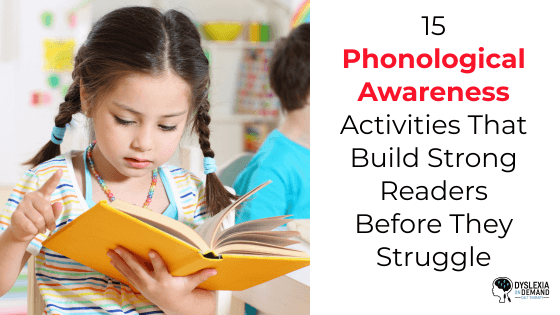
15 Phonological Awareness Activities That Build Strong Readers Before Reading Struggles Begin

Learn about phonological awareness activities that build strong readers

Parents often think reading begins when a child learns the alphabet. In reality, reading begins much earlier with phonological awareness, which is the ability to hear, recognize, and manipulate the sounds in spoken language. Research consistently shows that phonological awareness is one of the strongest predictors of future reading success, making it one of the most important skills children can develop before formal reading instruction begins.

If you are wondering what you can do today to help prepare your child for reading, the answer is surprisingly simple. Spend a few minutes each day playing with spoken language. The best phonological awareness activities happen through conversation, laughter, songs, and word play long before a child ever opens a reading book.

What Is Phonological Awareness?

Phonological awareness is an entirely auditory skill. It is about hearing and playing with the sounds inside spoken words, and it develops before children ever connect those sounds to printed letters.  It is an entirely auditory skill that develops before children learn to connect sounds to printed letters.

One of the biggest misconceptions parents have is believing that phonological awareness involves letters or books. It does not.

Children do not need to know the alphabet.

They do not need to recognize printed words.

They do not need to spell.

Instead, they simply learn to listen carefully to spoken words and discover that words are made up of smaller parts that can be broken apart, blended together, and changed.

For example, when a child notices that cat and hat rhyme, they are demonstrating phonological awareness.

When they clap the syllables in watermelon, they are demonstrating phonological awareness.

When they can tell you that football without foot is ball, they are demonstrating phonological awareness.

None of these activities require reading. They are all listening games.

Later, when children begin phonics instruction, they connect those sounds they already understand to printed letters. That process is much easier when the brain already understands how spoken language works.

As a Certified Academic Language Therapist, one of the books I recommend most often to both parents and educators is Equipped for Reading Success by Dr. David Kilpatrick. His research has transformed how we understand reading development and why phonological awareness deserves attention long before formal literacy instruction begins.

Why Is Phonological Awareness So Important?

Phonological awareness is the foundation upon which reading is built.

Imagine building your dream home. You spend months choosing the perfect floor plan, beautiful windows, custom cabinets, and every finishing touch. Then the builder tells you they are planning to build the entire house on sand.

No one would agree to that.

Without a strong foundation, even the most beautiful home will eventually develop cracks.

Reading works exactly the same way.

Phonological awareness is the foundation that supports every other reading skill. When children understand that spoken words are made up of individual sounds, they are much better prepared to learn phonics, spelling, and fluent reading.

Without that foundation, reading often becomes much harder. Children spend so much mental energy trying to figure out individual words that they have little energy left to understand what they are reading.

Dr. David Kilpatrick’s research consistently identifies phonological awareness, particularly phonemic awareness, as one of the strongest predictors of future reading success. His work has also demonstrated that explicit instruction in these skills can significantly reduce reading difficulties for many children.

Like building a house, it is much easier to pour a strong foundation before adding the walls than it is to repair structural problems later.

Is Phonological Awareness the Same as Phonics?

No. Although the terms are often used interchangeably, phonological awareness and phonics are two different skills that work together.

Phonological awareness is the ability to hear and manipulate sounds in spoken language.

Phonics is learning how those sounds connect to printed letters.

Think of phonological awareness as preparing the brain for reading.

Think of phonics as teaching the brain how to read print.

Children first learn that words are made up of sounds. Then they learn that letters represent those sounds.

When children have a strong phonological awareness foundation, learning phonics becomes much easier because the sounds already make sense. They are simply attaching symbols to something they already understand.

This is one reason experts recommend developing phonological awareness before or alongside formal phonics instruction rather than waiting until reading problems appear. These skills sit inside a much larger body of evidence about how children learn to read

Why Does Phonological Awareness Matter Even More for Children with Dyslexia?

Every child benefits from phonological awareness activities.

Children with dyslexia simply depend on them even more.

Dyslexia primarily affects the brain’s ability to process the sounds within spoken language. Because of this, many children with dyslexia need far more explicit opportunities to hear, blend, segment, and manipulate sounds than their peers.

That does not mean these children cannot become excellent readers.

It simply means they often need more intentional practice building the foundation before expecting the structure to stand.

The wonderful news is that phonological awareness activities rarely feel like school.

Children think they are playing games.

They laugh at silly rhymes.

They invent nonsense words.

They clap syllables.

They play “I Spy.”

Meanwhile, their brains are strengthening the neural pathways that support future reading.

This is why I encourage every family to begin these activities before reading struggles appear. Waiting until a child falls behind means trying to strengthen the foundation after the house has already been built.

Children with dyslexia often need this kind of sound work built directly into their reading instruction, delivered far more explicitly than a typical classroom provides. 

When Should Parents Start Phonological Awareness Activities?

Parents often ask if they should wait until kindergarten before working on reading skills.

My answer is almost always the same.

Start sooner.

Phonological awareness activities can begin long before children recognize letters or read their first words.

Many of the best opportunities happen naturally during everyday life.

During bath time.

While driving to preschool.

Walking through the grocery store.

Playing outside.

Waiting at a restaurant.

Reading bedtime stories.

Children do not need worksheets or flashcards. They simply need adults who enjoy talking, singing, rhyming, and playing with language.

Those five-minute conversations often become some of the most valuable reading preparation a child ever receives.

If your child is already past this stage and reading is not clicking, it may be worth looking into whether an evaluation makes sense

Activity 1: Rhyming Games

Rhyming is often one of the earliest phonological awareness skills children develop.

Ask simple questions such as:

“What rhymes with cat?”

“What rhymes with tree?”

Don’t worry if the answers are silly.

In fact, nonsense words are wonderful because they require children to focus on sounds rather than meaning.

Children might say that zat rhymes with cat.

Perfect.

That demonstrates they are listening to the sounds.

Activity 2: Syllable Clapping

Choose words from everyday life.

Family members’ names.

Animals.

Foods.

Favorite television characters.

Say each word slowly while clapping the syllables together.

For example:

Ba-na-na.

El-e-phant.

Pic-nic.

Children quickly begin to recognize that long words are made up of smaller sound units.

Activity 3: Beginning Sound Detective

Choose a sound for the day.

Maybe the /m/ sound.

Then spend the day finding objects that begin with that sound.

Milk.

Moon.

Monkey.

Muffin.

Mirror.

Children love becoming “sound detectives.”

More importantly, they are learning to notice the individual sounds that make up spoken words.

Activity 4: “I Spy” Using Sounds

Instead of saying,

“I spy something blue.”

Try saying,

“I spy something that starts with /b/.”

Or,

“I spy something that begins with /s/.”

Children search for objects while thinking about beginning sounds rather than visual characteristics.

This strengthens one of the earliest building blocks of reading.

Activity 5: Compound Word Games

Compound words provide a wonderful introduction to manipulating spoken language.

Ask questions like:

“What two words make the word snowman?”

“What two words make cupcake?”

Then reverse the activity.

Ask:

“What word do you have if you say football without foot?”

Children usually delight in figuring out that the answer is “ball.”

Without realizing it, they are practicing one of the exact skills that supports later reading development.

Activity 6: Ending Sound Challenge

Once children become comfortable identifying beginning sounds, begin asking about ending sounds.

For example, ask:

“What sound does dog end with?”

“What sound do you hear at the end of fish?”

“What sound does jump end with?”

Children begin listening more carefully to every sound within a word rather than focusing only on the beginning.

This skill becomes increasingly important as they prepare for spelling and decoding.

Activity 7: Stretch the Sounds

Choose a simple word like sun.

Instead of saying it normally, slowly stretch each sound.

“/ssss/…/uuu/…/nnnn/”

Then ask your child to blend the sounds together into the whole word.

Later, switch roles and let your child stretch the sounds while you blend them.

This activity develops one of the most important skills needed for early decoding.

Activity 8: Blend the Sounds

Instead of saying a whole word, separate each individual sound.

For example:

“/d/…/o/…/g/”

Ask,

“What word am I saying?”

As children become more successful, increase the complexity of the words.

Blending individual phonemes together is one of the strongest predictors of future reading success.

Activity 9: Take Away a Sound

Once children become comfortable manipulating larger word parts, begin removing individual sounds.

Say,

“Say cat.”

Now ask,

“Say cat without the /k/.”

The answer becomes at.

Later try,

“Say smile without the /s/.”

These activities are challenging, but according to Dr. David Kilpatrick, phoneme deletion is one of the strongest indicators of reading readiness.

Activity 10: Switch the First Sound

This game teaches children that changing one sound creates an entirely different word.

Say,

“Change the /m/ in mat to /s/.”

Now the word becomes sat.

Try,

“Change the /h/ in hat to /c/.”

The word becomes cat.

Children begin understanding how individual sounds affect meaning.

Activity 11: Silly Alliteration

Children love tongue twisters.

Try saying things like:

“Silly Sammy slurps soup.”

“Busy bees bake brownies.”

Then ask your child what sound keeps repeating.

This develops awareness of beginning sounds while making language playful.

Activity 12: Odd One Out

Give your child three words.

For example:

Sun

Sock

Dog

Ask,

“Which word doesn’t belong?”

The answer is dog because it begins with a different sound.

Later, increase the difficulty by focusing on ending sounds or middle vowel sounds.

Activity 13: Nonsense Words

This is one of my favorites because it surprises parents.

According to Dr. David Kilpatrick, nonsense words are incredibly valuable because children cannot rely on memorization.

Ask questions like:

“What rhymes with lat?”

“What rhymes with pim?”

“What happens if we change the first sound in bep?”

Children must focus entirely on sounds instead of meaning.

That is exactly what phonological awareness is.

Activity 14: Sound Counting

Choose a simple word.

Ask your child,

“How many sounds do you hear in ship?”

Not letters.

Sounds.

Children often discover that words contain more or fewer sounds than they expected.

This strengthens phoneme awareness while preparing them for later spelling instruction.

Activity 15: Make It Part of Everyday Life

Perhaps the most important activity is not really an activity at all.

It is making phonological awareness part of everyday conversation.

Play sound games while driving.

Talk about rhyming words during bath time.

Count syllables while grocery shopping.

Change beginning sounds during bedtime stories.

Laugh.

Be silly.

Have fun.

Children learn best when they don’t realize they are practicing.

Five playful minutes each day is far more valuable than one long lesson each week.

You Don’t Need Fancy Materials

One of the best things about phonological awareness is that it costs absolutely nothing.

You don’t need flashcards.

You don’t need worksheets.

You don’t need an expensive reading curriculum.

Most of these activities happen through conversation.

They happen while waiting in line.

Driving to soccer practice.

Cooking dinner.

Walking the dog.

Bath time.

Those small moments add up in remarkable ways.

Final Thoughts

Parents often ask me what they can do before their child begins formal reading instruction.

My answer is almost always the same.

Build phonological awareness.

Research consistently demonstrates that phonological awareness is one of the strongest predictors of future reading success, and few researchers have contributed more to our understanding of this relationship than Dr. David Kilpatrick.

His book, Equipped for Reading Success, is one of the resources I recommend most often to educators and families because it transforms decades of reading research into practical, engaging activities that can be used every day.

The wonderful news is that these activities benefit every child.

Children with dyslexia simply depend on them even more.

By investing just a few playful minutes each day before formal reading instruction begins, you are helping your child’s brain build the foundation upon which every future reading skill will rest.

That foundation may become one of the greatest gifts you ever give your child.

FAQs 

What is the difference between phonological awareness and phonemic awareness?
Phonological awareness is the broad ability to hear and work with sounds in spoken language, including rhymes, syllables, and individual sounds. Phonemic awareness is one part of it, focused specifically on the smallest sounds, or phonemes. Phonemic awareness is the strongest predictor of reading success.

Can these activities help a child who already struggles with reading?
Yes. Phonological awareness activities help at any age, not only before reading begins. Older children who struggle often have gaps in these foundational sound skills, and targeted practice can strengthen them even after formal reading instruction has started.

How do I know if my child is behind with phonological awareness?
Some variation is normal, but a child who cannot hear rhymes, clap syllables, or identify beginning sounds by kindergarten may need closer attention. Persistent difficulty with sounds is one of the earliest signs of dyslexia and worth discussing with a specialist.

Do these activities replace phonics or formal reading instruction?
No. Phonological awareness prepares the brain for reading, but children still need explicit phonics instruction to connect sounds to letters. These activities work best alongside, or just before, structured reading instruction rather than in place of it.

How much time should we spend on phonological awareness each day?
A few minutes is enough. Five playful minutes each day is far more valuable than one long weekly lesson. Short, consistent practice woven into everyday routines builds these skills more effectively than formal sit-down sessions.

References

Kilpatrick, D. A. (2016). Equipped for Reading Success: A Comprehensive, Step-by-Step Program for Developing Phoneme Awareness and Fluent Word Recognition.

Kilpatrick, D. A. (2015). Essentials of Assessing, Preventing, and Overcoming Reading Difficulties.

Louisa Moats. Speech to Print: Language Essentials for Teachers.

International Dyslexia Association. Structured Literacy: Effective Instruction for Students with Dyslexia and Related Reading Difficulties.

National Center on Improving Literacy. Phonological Awareness Resources for Families.

The Reading League. The Science of Reading: Defining Guide.

About the Author

Megan Pinchback is the founder of Dyslexia On Demand, a virtual dyslexia therapy company serving students around the world. She is a Certified Academic Language Therapist (CALT), Licensed Dyslexia Therapist (LDT), dyslexia advocate, national speaker, podcaster, and social media educator dedicated to helping families better understand dyslexia, Structured Literacy, the Science of Reading, advocacy, and the social-emotional impact of learning differences.

Through Dyslexia On Demand, Megan has helped thousands of families navigate dyslexia by connecting them with highly trained Certified Academic Language Therapists who provide individualized, data-driven intervention rooted in Structured Literacy. She is passionate about helping parents understand not only what works, but why it works, empowering families to become confident advocates for their children both inside and outside the classroom.

Megan is also the co-host of the Don’t Call On Me podcast, where she interviews leading researchers, educators, and individuals with dyslexia to make evidence-based literacy information accessible to families and educators alike. As a mother of five and grandmother to one, she understands both the professional and personal sides of helping children become confident, successful readers.
Tags:

    Comments are closed

    Posted by
    Megan Pinchback
    leadgem.marketing@gmail.com
    Megan Pinchback is the founder and owner of Dyslexia on Demand and a Certified Academic Language Therapist (CALT). She is also the co-host of the Don't Call on Me Podcast, a national speaker on dyslexia, social media educator and advocate, mom of five, and grandma to one. Through her work, she is passionate about helping families better understand dyslexia, access evidence-based support, and feel less alone in the journey.
    Real People. Real Results. Real Progress.

    What Our Families & Partners Are Saying

    Excellent
    Dyslexia On Demand5.0
    Based on 79 reviews
    Viva La Eva
    14 hours ago
    recommends
    I cannot say enough wonderful things about Dyslexia On Demand and the impact their therapy has had on my daughter. When we started this program, I wanted more than anything to help my daughter feel confident in herself as a learner again. The transformation has been incredible. She is now so much more confident, motivated, and willing to learn. She has caught up to grade level in reading and is doing so much better in math as well. One of the biggest changes I’ve noticed is in her happiness. She no longer comes home crying or feeling defeated because school is too difficult. Instead, she wakes up early every day excited to go to school. As a parent, seeing that change has meant everything to me. The knowledge and strategies she gained through Dyslexia On Demand have given her the tools to understand how she learns and, more importantly, the confidence to believe in herself. This program has made such a meaningful difference not only academically, but emotionally and personally. I am incredibly grateful to everyone at Dyslexia On Demand for the time, dedication, knowledge, and support they have given my daughter. You have helped her find confidence in herself and joy in learning again, and that is something I will always appreciate. Thank you from the bottom of my heart for everything you have done for her. I truly cannot express how grateful I am.
    Thatcher is thriving in Dyslexia on Demand. He told me the other day that his favorite subject was writing!!! I about fell out of my seat!! He loves his sessions with Taylor and his writing, spelling, and reading are really progressing. This has certainly changed the course of his educational path forward. We couldn't be more pleased!
    Richard cuffle
    1 month ago
    We absolutely love Miss Mary and everyone at Dyslexia on Demand. ❤️ Issabella has grown so much, not only in her reading, but in her confidence, her faith in herself, and her willingness to keep pushing through challenges. Miss Mary has played such a huge role in helping her believe in herself again, and that means more to our family than words can express.
    Richard Cuffle
    1 month ago
    recommends
    We absolutely love Miss Mary and everyone at Dyslexia on Demand. ❤️ Issabella has grown so much, not only in her reading, but in her confidence, her faith in herself, and her willingness to keep pushing through challenges. Miss Mary has played such a huge role in helping her believe in herself again, and that means more to our family than words can express.
    Esmi E
    2 months ago
    The BEST thing we have ever done is to put our hope and trust with Dyslexia On Demand. Communication with parents is speedy and supportive. The love and patience give to our son is top notch!! They are part of our success story and can never thank them enough!
    Ashley Novosad
    3 months ago
    recommends
    We have had an incredible experience with Dyslexia on Demand! My daughter, Bella, absolutely loves her teacher, Miss Mary. ❤️ Issabella participates in the daily one hour intervention sessions, and she actually loves jumping on the calls every single day. In just a very short amount of time, we have seen tremendous growth. Her reading skills have improved significantly, but the biggest transformation is her confidence. You can truly see how much more confident she has become in her abilities. We are so grateful for Miss Mary and the amazing program at Dyslexia on Demand. I highly recommend them to any family looking for effective, engaging, and life-changing reading support!
    Jennifer Carl
    4 months ago
    I cannot speak highly enough about Dyslexia on Demand and the impact it has had on our son, Tripp. I want to share our story because I believe it’s proof of what’s possible when the right people come alongside your child. This past spring, during a parent-teacher conference following his IOWA test results, I sat in a room with administrators and faculty as they explained—quite frankly—how much of a “problem” Tripp was perceived to be. At the time, he was being bullied by the principal’s son, and I had voiced strong concerns about the lack of structure, discipline, curriculum issues, and troubling social dynamics. I could see Tripp declining emotionally, mentally, and academically. Things had reached a point where, one day in the carpool line, he jumped out of the car and ran down the street screaming that he wasn’t going back to school. The campus police officer and school counselor became involved—but even then, the school still labeled him as the problem. I left that spring meeting with a heavy heart and a clear conviction: it was time to pull both of our children out of the school. We didn’t have a plan yet, but I knew in my gut that I could give them better than what they were receiving at the so-called “best” private school in our small town. I remember crying in the car afterward and sending Megan an emotional, long-winded email—much like this one—feeling like I had somehow failed my son. Fast forward to today, and I want to share something that still gives me chills: Tripp’s test results from Liberty University Online Academy now show that not only is he working at grade level—he is at the very top of his class. His confidence is unmistakable, and his light is back. From the deepest place in my mama heart, thank you. Partnering with Dyslexia on Demand, and with Mrs. Suzanne specifically, has been one of the greatest blessings on this journey. Their work is truly changing lives—and I have the proof, right here in my thriving boy.
    sara corder
    5 months ago
    Amity is amazing at keeping our 3rd grader engaged in the program and is always accommodating when needed. It has been refreshing to feel supported and not judged during times when our daughter is experiencing cognitive overload from school testing and then comes home to do more work. Amity clearly understands neurodivergent children and students with disabilities, and how their brains work. I especially appreciate her warm and gentle demeanor when our child is off task and needs redirection. There have even been times when I started to step in to encourage my child to participate, only to realize that Amity already had it handled. That level of confidence, patience, and skill is something our previous provider was lacking. I am so excited that my child can participate in therapy four times a week for an hour each session. This would have been beyond unmanageable previously. Amity is a fabulous fit, and so is your program. Everything flows so nicely.
    Abril Perea
    5 months ago
    “Watching Joseph grow through Dyslexia On Demand has been nothing short of life changing for our family. What once felt overwhelming now feels full of possibility because of the support and guidance they provide. They have helped my son build confidence, strength, and belief in himself as a learner. As parents, we are deeply grateful for the difference Dyslexia Online has made in Joseph’s life.” Thank you Abril 😀
    recommends
    We are only 2.5 months into my daughter’s Dyslexia on Demand program, and we are already seeing improvements. We opted for the group therapy lessons, and they have been great. She absolutely loves her sweet teacher, Ms. Heather, and looks forward to seeing her each week. We’ve noticed she is gaining much more confidence in her reading and is starting to truly enjoy it. I can’t wait to see what the future holds for her as she continues with the program.
    Janell Weaver
    7 months ago
    My learner never had access to structured literacy before. Dyslexia on Demand is literally changing the trajectory of their life by helping them become a reader. Edited to add- Dyslexia on Demand and our therapist Elizabeth are amazing. My son needs fairly significant support. I imagine it could be easy to feel that he is too difficult to serve given his struggles with language and attention. But Elizabeth has never wavered. I sense she's just as committed to his success as I am, and it feels like such a relief to finally have that kind of partner. She has had a tremendous impact on our family by giving us greater hope for our son's future. My appreciation for her could never be overstated.
    Janell Weaver
    7 months ago
    recommends
    Dyslexia on Demand and our therapist Elizabeth are amazing. My son needs fairly significant support. I imagine it could be easy to feel that he is too difficult to serve given his struggles with language and attention. But Elizabeth has never wavered. I sense she's just as committed to his success as I am, and it feels like such a relief to finally have that kind of partner. She has had a tremendous impact on our family by giving us greater hope for our son's future. My appreciation for her could never be overstated.
    Torrie Guerrero
    11 months ago
    Our daughter,Emersyn, has been with Dyslexia on Demand for a couple years now! We are so pleased with all the services they provide! She has had two therapists and both have been knowledgeable,patient,helpful,and kind. They see her! The curriculum is very comprehensive! Emersyn has gained so much confidence in reading and spelling! We look forward to her future progress with Dyslexia on Demand! Thank you Dyslexia on Demand!
    Nicole Hendricks
    11 months ago
    Two of my children receive therapy from Dyslexia on Demand. Both are thriving and making incredible progress! My son has been working with Brooke for less than a year and has grown in his reading skills and his confidence! His change of heart towards reading and learning has been a beautiful transition to watch and has brought me peace of mind and relief watching him get on the right track and receive the support he needed. Most extraordinarily though, my 11 year old daughter was diagnosed with dyslexia at age 7 and has struggled so much through the years. She has undergone intensive therapies and even attended a dyslexic private school for a few years, where she received specialized instruction and one-on-one therapy daily. Even after years of therapy and specialized education, she started 5th grade, last year, with a 3.2 reading level. A year later, her STAR testing showed she was starting 6th grade with a 7.8 reading level! Dyslexia on Demand and her provider, Kim, have so much to do with her progress, confidence and success. To watch that gap finally close and to witness my child read confidently is a joy I can’t describe and has been worth every investment of time and resources! I can not adequately describe the impact Dyslexia on Demand has had on our lives, but to put it simply, I am so genuinely impressed, grateful and thankful!
    Beth Thomas
    12 months ago
    I can't speak highly enough of Dyslexia On Demand - from my first conversation with Megan I felt an understanding of everything we had been dealing with through the years. She was able to quickly help me understand what my child needed and what we needed to do. My daughter is in high school and at first didn't want to think about therapy, but she loves her therapist, Suzanne. She is always ready for her session which I think speaks volumes and is continuing to build her confidence. We are excited to see her continued growth through the program.
    Tyler Watt
    12 months ago
    Dyslexia on Demand has been such a blessing for our little girl! Since starting this 2yr course which she will be finishing in a year in half- we went from not remembering site words or barely remembering sounds of letters and decoding to reading past a 3rd grade level! This has been such a treat to watch! Are therapist is like being part of our little family
    Jinni Henry
    12 months ago
    Dyslexia on Demand has been absolutely life-changing for my daughter. Before we found them, reading felt overwhelming and discouraging for her, but now she is growing in confidence every week. The one-on-one support and specialized approach have truly made all the difference. Her tutor is patient, encouraging, and really understands how to meet her where she is. Not only has her reading improved, but her overall confidence.
    Stephanie Garrido
    12 months ago
    My 9 year old daughter started Dyselxia on Demand in June 2 and this is the only intervention we have constantly seen growth with since being diagnosed with dyslexia. We immediately saw growth in fluency, ability to access curriculum and writing. Her confidence is building and we are finding her reading for pleasure which has been so heartweraring. A CALT, using a research based program is exactly what she needed. This was the answer to our prayers and we are excited to see her continue to grow! We have worked with 2 CALT's and they have both been engaging, positive, caring and great communicators.
    Hun Epps
    1 year ago
    My friend, whose SIL works for DOD, recommended the company. And I'm so grateful! Reasonably priced and my daughter's reading has astronomically improved - she's reading much better than I had ever expected after having started this past summer! She loves her therapist and she's spontaneously reading on her own with significantly improved fluency. I'm no longer worried about her confidence; her spelling as improved. I'm hoping to continue past her therapy so her reading continues to strengthen to its fullest capacity.
    Heather Adams
    1 year ago
    We’ve had such a wonderful experience with Dyslexia on Demand. My son has struggled with reading for years, but since starting with his instructor, his reading skills have improved dramatically. Even more importantly, his confidence has grown so much. He no longer gets discouraged when reading and is actually starting to enjoy it. The patience, knowledge, and encouragement provided have made all the difference. I am so grateful for the support they’ve given our family and highly recommend them to anyone whose child is struggling with reading or dyslexia.
    Kristin Hasty
    1 year ago
    Having a child with a learning difference can sometimes be difficult to navigate! Unfortunately kids don't come with a manual and definitely not children that learn "outside of the norm". Our son went to a school for kids with learning differences and after 5 years we weren't convinced he would ever read on grade level, so by the time we found DoD we were desperate. We met with Megan and she settled our mind that there was a therapist that could meet our teenage son where he was and with time and effort he would read! She paired us with a therapist that had experience working with older, maybe a little more resistant children. We love Brooke! Easton loves Brooke and he really, truly looks forward to their sessions together. Thank you so much to all of the staff at DoD and a special shoutout to our therapist, Brooke. Easons future is looking bright!
    Alisha Brown
    1 year ago
    This dyslexia program is the best of the best! We love our CALT, Lauren B.! My daughter was slow going then it clicked about 9 months in (so keep at it, trust the process)! I highly recommend Dyslexia on Demand!!
    Alisha Brown
    1 year ago
    recommends
    This program is the best of the best! We love our CALT, Lauren! My daughter was slow going then it clicked about 9 months in (so keep at it, trust the process)! I highly recommend Dyslexia on Demand!!
    Holly Moore
    1 year ago
    My daughter has had a tutor through Dyslexia on Demand for over 2 years and it was the best decision we ever made. Lisa, her tutor, is patient, accommodating to our schedule and really wants to see my daughter succeed. AMAZING COMPANY!
    Dimple Amin
    1 year ago
    My son has been doing the DOD program for 4 months now. I am impressed by how thorough the program is. The whole team is dedicated to informing and supporting both parents and their children. Our tutor is awesome! She has over 30 years of experience and is great with my son. She is also flexible with our schedule. The whole program takes a couple years on average, but for the support it offers children who would otherwise spend their school years struggling, it is well worth it. I have already seen more confidence in my son. I am glad this program offers highly qualified dyslexia tutors that we would otherwise not have access to in our area.
    Logo with a silhouette of a head containing lightning bolts and a USB cord as the neck. Text reads “Dyslexia On Demand, CALT Therapy,” with “On Demand” and “CALT Therapy” in blue.Outline of a head with lightning bolts in the brain area, a USB cord at the neck, and the text “Dyslexia On Demand. Therapy Reimagined” to the right in large, light blue and white letters.
    We believe every child deserves the opportunity to learn to be academically successful regardless of learning style or academic challenges.