
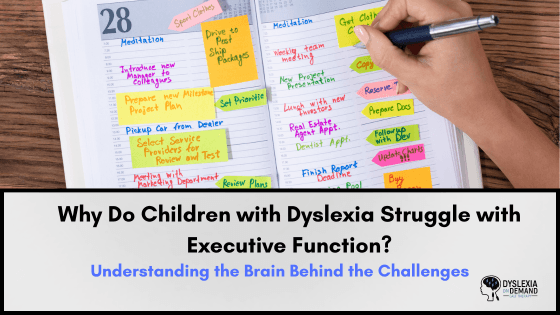
Children with dyslexia often struggle with executive function because reading requires significantly more mental effort than it does for typical readers. When the brain must devote more energy to decoding words, fewer cognitive resources remain for planning, organization, working memory, attention, and emotional regulation. This does not reflect a lack of intelligence or motivation. It reflects how the dyslexic brain processes language.
If you’ve ever watched your child come home from school completely exhausted, you’ve probably wondered how a day spent sitting in a classroom could leave them so drained.
Maybe they spend an hour completing homework only to forget to turn it in the next morning. Perhaps they cannot remember three simple directions, yet they can recite every statistic about their favorite athlete or tell you every detail of a movie they watched months ago. Their backpack is overflowing with crumpled papers. Starting an assignment requires constant reminders. Emotions seem especially big after school.
It can feel confusing because your child is clearly intelligent.
Parents often hear comments like, “They just need to get organized,” or “They need to pay better attention.” While those statements may sound reasonable, they fail to explain what is actually happening inside the brain.
Many of these challenges have very little to do with intelligence, effort, or motivation. Instead, they are often connected to the relationship between dyslexia and executive function.
Understanding that relationship changes everything. It helps explain why children with dyslexia often struggle with much more than reading. Once you understand how the brain works, those struggles begin to make sense.
If you are new to the term, start with what executive function is and how it develops. This article explains why the connection to dyslexia is so strong.
Reading is one of the brain’s most complex jobs. For children with dyslexia, recognizing words is not automatic, so reading requires far more mental effort. That extra effort leaves fewer cognitive resources available for executive functioning skills like planning, organization, and working memory.
To understand why dyslexia and executive function are so closely connected, it helps to understand what happens during reading.
For skilled readers, word recognition eventually becomes automatic. Their brains identify familiar words almost instantly. That allows them to focus on understanding the story, making predictions, visualizing ideas, and connecting information.
Children with dyslexia experience something very different.
Their brains often work much harder to identify sounds, connect those sounds to letters, blend words together, and recognize unfamiliar words. Every sentence demands considerably more mental energy.
Imagine driving down a familiar highway. After years of experience, much of the drive feels automatic. You can carry on a conversation while still paying attention to the road.
Now imagine driving through a blizzard at night on unfamiliar mountain roads.
Suddenly, every bit of your attention is devoted to staying in your lane. You grip the steering wheel tighter. The conversation stops. Every decision requires your full concentration.
That is much closer to what reading feels like for many children with dyslexia.
The brain is working incredibly hard simply to decode the words on the page.
Children with dyslexia often have fewer mental resources available for executive function because so much of their cognitive energy is devoted to reading and spelling. As a result, organization, working memory, planning, emotional regulation, and attention may all become more difficult, even though the child is highly capable.
One of the easiest ways to understand this relationship is to think about your smartphone.
When only a few applications are running, your phone responds quickly. Everything opens smoothly. Switching between tasks feels effortless.
Now imagine twenty applications running at the same time.
The phone begins slowing down. Opening another app takes longer. The battery drains more quickly. Tasks that normally feel simple suddenly require more effort.
The phone is not broken.
It is simply using most of its available resources.
The brain works in a remarkably similar way.
Every cognitive task requires mental resources. Reading, remembering directions, organizing materials, solving problems, regulating emotions, and planning ahead all compete for those same resources.
For children with dyslexia, decoding words and spelling often uses a much larger share of those resources than it does for typical readers. That leaves less available for executive functioning throughout the school day.
This is one reason children with dyslexia may appear forgetful, disorganized, or overwhelmed, even though they are exceptionally bright.
It is not because they are incapable.
Their brains are simply working much harder than most people realize.
Working memory is one of the executive function skills most commonly affected in children with dyslexia. It allows us to temporarily hold information in our minds while using it. When decoding requires extra effort, working memory has less capacity available for everything else.
Imagine reading the sentence, The brown dog ran across the playground.
A skilled reader remembers the beginning of the sentence while reading the end. The entire sentence comes together almost effortlessly.
For a child with dyslexia, so much attention is devoted to decoding individual words that there is less working memory available to hold the sentence together.
The same pattern appears throughout the school day.
A teacher says, “Open your science book. Turn to page forty-two. Answer questions one through five.”
By the time the child remembers the first direction, the second or third may already be gone.
Parents often notice the same thing at home.
You ask your child to brush their teeth, put on pajamas, and bring downstairs tomorrow’s library book.
They brush their teeth and then wander into another room because the remaining directions have disappeared from working memory.
These are classic examples of executive function challenges. They have far more to do with cognitive load than motivation.
Planning and organization depend heavily on executive functioning. When reading already consumes much of a child’s mental energy, breaking large assignments into manageable steps becomes much harder.
Executive functioning helps us see the bigger picture.
When adults receive a large project, they automatically begin dividing it into smaller, manageable pieces.
Children are still learning that skill.
Children with dyslexia often have an even greater challenge because reading itself requires so much cognitive effort.
Imagine being assigned a book report.
First, you have to read the book.
Then you have to remember what happened.
Next, you organize your ideas, plan the report, write a draft, revise your work, check for spelling, and submit everything on time.
Every one of those steps depends on executive functioning.
If reading has already consumed much of the brain’s available resources, organizing everything that follows becomes much more difficult.
Parents sometimes mistake this for procrastination.
In reality, many children simply do not know where to begin because their executive functioning system is already overloaded.
One of the most overlooked aspects of executive function involves emotions.
Many people assume executive functioning only affects organization or memory.
In reality, emotional regulation is one of its most important responsibilities.
Children with dyslexia experience repeated academic frustration.
They may spend twice as long completing assignments.
They may answer questions correctly during class discussions but perform poorly on written tests.
They often compare themselves to classmates who seem to finish everything more quickly.
Over time, these repeated experiences place tremendous demands on emotional regulation.
A seemingly small frustration can trigger tears or anger because the brain has already been working overtime throughout the day.
Parents sometimes notice that after school is the hardest time of day.
That is not a coincidence.
Mental fatigue reduces the brain’s ability to regulate emotions effectively.
The emotional response is often the visible symptom of an invisible day spent working much harder than everyone else.
Check our dedicated article about dyslexia symptoms and understanding cognitive impact.
Another reason executive function and dyslexia are so closely connected involves processing speed.
Processing speed is the rate at which the brain takes in information, understands it, and responds. It is important to note that many children with dyslexia have average or even above-average processing speed on cognitive testing. However, when the task involves reading, spelling, or other language-based activities, their processing becomes significantly less efficient because decoding requires so much additional effort.
Imagine two people carrying groceries into the house.
One person has only a few lightweight bags and walks comfortably to the front door.
The other person is carrying several heavy boxes. They eventually arrive at the same destination, but they move more slowly because every step requires more effort.
Children with dyslexia often experience academic tasks in much the same way. Their brains are carrying a heavier cognitive load throughout the day.
As that mental effort accumulates, executive functioning becomes more difficult. Organizing materials, remembering directions, switching between assignments, and monitoring mistakes all require energy that may already be depleted.
This is one reason parents often notice that mornings begin relatively smoothly, while afternoons become increasingly challenging.
One of the questions parents ask most often is, “How can my child remember every dinosaur that ever lived but forget to bring home their homework?”
The answer once again lies in executive function.
Children with dyslexia usually have no difficulty remembering information that captures their interest and has been stored in long term memory. Facts about sports, animals, movies, or hobbies are often retrieved with remarkable accuracy because they have been learned deeply and repeatedly over time.
Executive functioning relies much more heavily on working memory.
Working memory manages information that must be held briefly while completing a task. It is temporary and constantly changing.
Remembering to bring home a permission slip requires working memory.
Remembering three verbal directions requires working memory.
Keeping track of materials throughout the school day requires working memory.
These are very different mental processes than recalling facts about a favorite hobby.
Understanding this difference often provides tremendous relief for parents. Their child’s memory is not “bad.” Instead, the challenge lies in managing information in the moment while juggling many competing demands.
The short answer is no.
Not every child with dyslexia demonstrates significant weaknesses in executive functioning. Dyslexia exists on a spectrum, and every child’s cognitive profile is unique.
Some children primarily struggle with phonological processing while demonstrating excellent organization and planning.
Others may have coexisting conditions such as ADHD, anxiety, or language disorders that contribute to more significant executive functioning challenges.
This is one reason comprehensive evaluation is so valuable.
An executive function assessment helps identify which skills are strengths and which areas may benefit from additional support. Rather than relying on assumptions, families can develop interventions that are tailored to the individual child.
Perhaps the greatest gift parents can give themselves is replacing judgment with understanding.
When we recognize what is happening inside the brain, many of our child’s behaviors suddenly make sense.
The forgotten homework is no longer viewed as carelessness.
The emotional outburst after school is no longer seen as overreacting.
The difficulty beginning assignments is no longer interpreted as laziness.
Instead, we recognize a child whose brain has been working exceptionally hard throughout the day.
This shift changes the questions we ask.
Instead of asking, “Why can’t you remember?”
We begin asking, “How can I reduce the demands on your working memory?”
Instead of saying, “Just get organized,” we begin teaching organization as a skill.
Instead of assuming our child lacks motivation, we recognize that they may simply be mentally exhausted.
That perspective creates more patience, more empathy, and more effective support.
Dyslexia has always been much more than a reading disability.
Reading is certainly the most visible challenge, but the effects often reach far beyond decoding words on a page.
Understanding the relationship between dyslexia and executive function helps explain why bright, capable children sometimes struggle with planning, organization, emotional regulation, working memory, and independence.
It also reminds us that these challenges are not reflections of intelligence or character.
They are the result of a brain working differently.
The encouraging news is that brains are remarkably adaptable.
With evidence-based instruction, supportive adults, explicit teaching, and time, children strengthen both their reading skills and many of the executive functioning abilities that support lifelong success.
When families understand the brain behind the challenges, they are better equipped to replace frustration with compassion and uncertainty with confidence.
That understanding may be one of the most powerful tools of all.
Is executive function difficulty part of dyslexia, or a separate condition?
Executive function difficulty is not part of the diagnostic definition of dyslexia, but it frequently occurs alongside it. For many children the difficulties are a consequence of the mental effort reading demands rather than a separate condition.
Will my child’s executive function improve as their reading improves?
Often yes. As decoding becomes more automatic, mental resources are freed for planning, memory, and organization. Many parents notice improvements in these areas within months of effective reading intervention. Read our other article to learn more on how to improve executive function skills in children with dyslexia.
Why is my child so much worse in the afternoon?
Executive function depends on mental energy, which depletes across the day. A child who has spent hours decoding text has less capacity left for organization and emotional regulation by the time they get home.
My child has dyslexia and ADHD. Are the executive function challenges worse?
Frequently, yes. ADHD affects executive function directly, while dyslexia affects it through cognitive load. When both are present the difficulties tend to be more persistent and benefit from support targeting each.
Does this mean my child will always need extra support with organization?
Not necessarily. Executive function continues developing into a person’s mid twenties, and explicit instruction accelerates it. Many adults with dyslexia manage complex jobs and households using systems they learned as students.
Center on the Developing Child at Harvard University. Executive Function & Self-Regulation. https://developingchild.harvard.edu/science/key-concepts/executive-function/
Yale Center for Dyslexia & Creativity. Research and Resources on Dyslexia and the Reading Brain. https://dyslexia.yale.edu/
National Institutes of Health. Developmental Dyslexia: The Role of Brain Imaging and Neuroscience Research. https://www.nih.gov/
International Dyslexia Association. Dyslexia Fact Sheets and Structured Literacy Resources. https://dyslexiaida.org/
International Literacy Association. Evidence-Based Literacy Research and Reading Instruction Resources. https://www.literacyworldwide.org/
University of Oxford. Department of Experimental Psychology: Research on Reading Development, Language, and Dyslexia. https://www.psy.ox.ac.uk/
Shaywitz, S. E. (2020). Overcoming Dyslexia (2nd ed.). Alfred A. Knopf.
Dawson, P., & Guare, R. (2018). Executive Skills in Children and Adolescents: A Practical Guide to Assessment and Intervention (3rd ed.). Guilford Press.
Baddeley, A. D. (2012). Working Memory: Theories, Models, and Controversies. Annual Review of Psychology, 63, 1–29.
Diamond, A. (2013). Executive functions. Annual Review of Psychology, 64, 135–168.
Megan Pinchback is the founder of Dyslexia On Demand, a virtual dyslexia therapy company serving students worldwide. She is a Certified Academic Language Therapist (CALT), dyslexia advocate, national speaker, podcaster, and social media educator focused on helping families better understand dyslexia, structured literacy, advocacy, and the social-emotional impact of learning differences. Megan is also a mother of five and grandmother to one living outside of Austin, Texas.


©2026 Dyslexia On Demand. All Rights Reserved.