
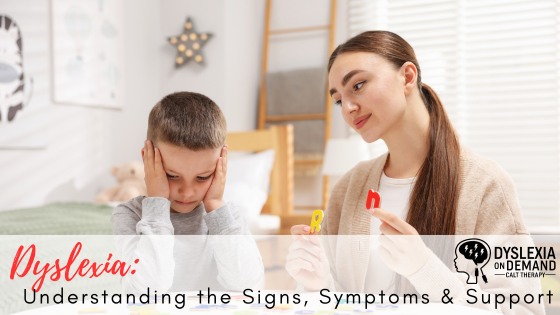
When families navigate a new dyslexia diagnosis, they must quickly transition into active learners. Navigating the modern educational landscape requires access to verified, evidence-based insights to understand how this condition structurally impacts a child’s daily life.
By understanding the underlying clinical symptoms of dyslexia, parents can successfully transition away from superficial academic remedies and access the specific therapeutic solutions their children need to thrive.
To understand the core symptoms of dyslexia, it is necessary to establish what the condition is not. Dyslexia is never a measure of a child’s baseline intelligence, raw capability, or desire to learn. It is a lifelong, inherited neurobiological condition that alters how the brain processes written and spoken language.
The fundamental root of dyslexia lies in a processing variance within the phonological system. This means the brain experiences a structural obstacle when trying to automatically break down, isolate, and manipulate individual sounds inside words. When a student lacks the automatic ability to map sounds to letters, the entire literacy foundation faces friction, impacting spelling accuracy, writing mechanics, and overall reading fluidness from early elementary school deep into adulthood.
While reading difficulties are the most visible outward sign, the true symptoms of dyslexia manifest across a broad spectrum of cognitive, academic, and behavioral areas. When these symptoms present themselves as an overlapping cluster, they point directly to a need for structured therapeutic intervention.
Because phonological processing is compromised, spelling symptoms are highly unpredictable and erratic. A student with dyslexia may spell a common word correctly in the first paragraph of an essay, only to spell it three different ways on the exact same page. They struggle deeply to envision the physical structure of a paragraph, retain proper sequence patterns, or remember explicit spelling rules despite continuous daily study.
One of the most profound symptoms of dyslexia in children is a stark mismatch between verbal competence and written output. A student can often listen to a complex question and immediately provide an intelligent, highly articulate, and sophisticated answer orally. However, when asked to write that identical response down on paper, the sentence structure collapses, vocabulary simplifies drastically, and the output fails to reflect their true cognitive capability.
A lack of reading comprehension in dyslexic students is directly tied to working memory limits. Because decoding is not automatic, the student must exhaust their entire supply of mental energy and working memory just to sound out individual words sequentially. By the time they reach the end of a single sentence, they have no remaining cognitive capacity left to store, process, or interpret the actual meaning of the text.
The neurological variances of dyslexia frequently impact broader executive processing networks. Symptoms regularly include persistent difficulty following multi-step verbal instructions, challenges with personal time management, chronic untidiness or disorganization with school materials, and a noticeable delay when attempting to quickly process receptive and expressive language under strict time limits.
When the core symptoms of dyslexia are left unmitigated by specialized therapy, they inevitably create secondary emotional and psychological challenges. Children acutely realize that their brains are processing text at a slower, more labor-intensive pace than their classmates, often leading to internalized stress.
When faced with these compounding symptoms, a family’s natural instinct is to hire a standard private tutor or search for after-school reading clubs. While a general academic tutor provides valuable help with organizing homework assignments, reviewing immediate grade-level curriculum, or practicing rote spelling lists, this approach is entirely superficial. Standard dyslexia tutoring manages the surface-level symptoms; it cannot treat the underlying neurobiological processing difference.
Long-term success requires formal clinical remediation through Structured Literacy. This method uses systematic, sequential, explicit, and cumulative instructional design to actively retrain the brain, forging entirely new neural pathways for language processing.
The undisputed gold standard for this model is the Orton-Gillingham methodology. Rather than relying on passive text exposure, an authentic Orton-Gillingham framework simultaneously engages visual, auditory, and kinesthetic-motor pathways to permanently cement the relationship between written letters and spoken sounds.
The overall effectiveness of a structured literacy program depends directly upon the specialization of the educator delivering it. Therapeutic grade intervention can only be administered by a Certified Academic Language Therapist (CALTs).
While standard reading coaches or classroom teachers can obtain basic certifications through brief weekend seminars, a CALT must meet elite national standards. This includes completing comprehensive post-graduate coursework, accumulating over 700 fully supervised clinical instructional hours, and passing the comprehensive national registration exam governed by the Academic Language Therapy Association (ALTA).
This extensive clinical background ensures the therapist can perform real-time error analysis, tailor the instructional pace dynamically, and provide a highly quantitative, diagnostic, and prescriptive treatment plan tailored specifically to your child’s cognitive profile.
It is vital to remember that while dyslexia introduces distinct processing challenges, it also correlates with exceptional cognitive strengths. Because their brains are wired differently, dyslexic individuals frequently possess remarkable capabilities outside the domain of linear text mechanics.
Students with dyslexia often score incredibly high in areas such as advanced spatial reasoning, complex three-dimensional design, artistic expression, engineering, inventive problem-solving, and abstract pattern recognition. By pairing their natural cognitive talents with the right clinical tools, children can successfully bypass mechanical processing barriers and confidently unlock their full potential in school and life.
You do not have to interpret symptoms or manage educational advocacy alone. Dyslexia on Demand specializes exclusively in providing premier, virtual dyslexia therapy options delivered by elite Certified Academic Language Therapists. By utilizing the renowned, research-proven Take Flight curriculum four times per week in an intensive, individualized setting, we actively build robust written language skills while nurturing independence and self-advocacy in every student.
Take control of your child’s educational roadmap. Connect with Dyslexia on Demand today at 888-292-3906, or visit DyslexiaonDemand.com to arrange your complimentary, professional consultation.
While formal clinical diagnoses typically occur when children begin formal reading instruction in elementary school, foundational dyslexia symptoms are often observable as early as preschool or kindergarten. Early indicators are heavily linked to language development and auditory processing. Parents should look for frequent mispronunciations of common multisyllabic words, persistent articulation challenges, delays in both receptive and expressive language, an inability to recognize letters in their own name, or a distinct lack of interest in learning the alphabet and rhyming words.
No, dyslexia is a permanent neurobiological condition, and individuals do not outgrow the underlying processing variance. However, with the timely implementation of evidence-based interventions, systematic accommodations, and professional dyslexia therapy, individuals can successfully build robust neural pathways for literacy. With the right support, dyslexic students routinely become highly fluent readers and writers who excel both academically and professionally.
When the core linguistic symptoms of dyslexia go untreated, they frequently manifest as secondary behavioral and emotional coping mechanisms. Because reading takes an immense amount of cognitive energy, children quickly become fatigued and frustrated. Outwardly, this presents as severe reading avoidance, stalling tactics or emotional outbursts during homework, extreme anxiety when asked to read aloud, and physical somatic complaints like headaches or stomach aches before school.
Dyslexia significantly impacts verbal short-term and working memory networks in the brain. This structural variance makes it incredibly difficult for a student to hold onto sequential auditory information. Common working memory symptoms include an inability to remember multi-step verbal instructions, difficulty memorizing rote sequential lists like the days of the week or the alphabet, and a profound struggle to comprehend a paragraph because the student’s entire mental capacity is completely exhausted by the physical mechanics of decoding the words.
American Academy of Pediatrics, Council on Children with Disabilities, & Section on Developmental and Behavioral Pediatrics. (2019). Identifying and supporting children with specific learning disabilities. Pediatrics, 144(6), e20193048. https://doi.org/10.1542/peds.2019-3048
Gaab, N. (2017). It’s a myth that young children cannot be screened for dyslexia! International Dyslexia Association. https://dyslexiaida.org/its-a-myth-that-young-children-cannot-be-screened-for-dyslexia/
International Dyslexia Association. (2017). Definition of dyslexia. International Dyslexia Association. https://dyslexiaida.org/definition-of-dyslexia/
National Center for Learning Disabilities. (2020). The state of learning disabilities: Understanding the 1 in 5. NCLD. https://www.ncld.org/
Shaywitz, S. E., & Shaywitz, B. A. (2020). Overcoming dyslexia: Second edition. Vintage.
Snowling, M. J., & Hulme, C. (2020). Interventions for children’s language and literacy difficulties. International Journal of Language & Communication Disorders, 55(3), 255–269. https://doi.org/10.1111/1460-6984.12525


©2026 Dyslexia On Demand. All Rights Reserved.