
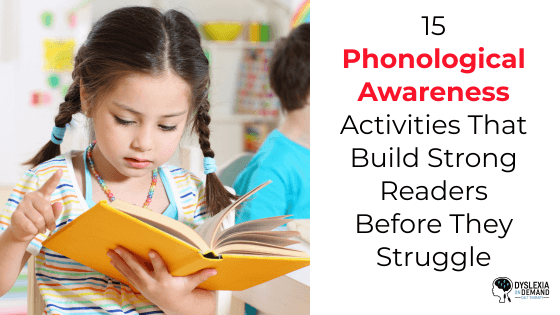
Parents often think reading begins when a child learns the alphabet. In reality, reading begins much earlier with phonological awareness, which is the ability to hear, recognize, and manipulate the sounds in spoken language. Research consistently shows that phonological awareness is one of the strongest predictors of future reading success, making it one of the most important skills children can develop before formal reading instruction begins.
If you are wondering what you can do today to help prepare your child for reading, the answer is surprisingly simple. Spend a few minutes each day playing with spoken language. The best phonological awareness activities happen through conversation, laughter, songs, and word play long before a child ever opens a reading book.
Phonological awareness is an entirely auditory skill. It is about hearing and playing with the sounds inside spoken words, and it develops before children ever connect those sounds to printed letters. It is an entirely auditory skill that develops before children learn to connect sounds to printed letters.
One of the biggest misconceptions parents have is believing that phonological awareness involves letters or books. It does not.
Children do not need to know the alphabet.
They do not need to recognize printed words.
They do not need to spell.
Instead, they simply learn to listen carefully to spoken words and discover that words are made up of smaller parts that can be broken apart, blended together, and changed.
For example, when a child notices that cat and hat rhyme, they are demonstrating phonological awareness.
When they clap the syllables in watermelon, they are demonstrating phonological awareness.
When they can tell you that football without foot is ball, they are demonstrating phonological awareness.
None of these activities require reading. They are all listening games.
Later, when children begin phonics instruction, they connect those sounds they already understand to printed letters. That process is much easier when the brain already understands how spoken language works.
As a Certified Academic Language Therapist, one of the books I recommend most often to both parents and educators is Equipped for Reading Success by Dr. David Kilpatrick. His research has transformed how we understand reading development and why phonological awareness deserves attention long before formal literacy instruction begins.
Phonological awareness is the foundation upon which reading is built.
Imagine building your dream home. You spend months choosing the perfect floor plan, beautiful windows, custom cabinets, and every finishing touch. Then the builder tells you they are planning to build the entire house on sand.
No one would agree to that.
Without a strong foundation, even the most beautiful home will eventually develop cracks.
Reading works exactly the same way.
Phonological awareness is the foundation that supports every other reading skill. When children understand that spoken words are made up of individual sounds, they are much better prepared to learn phonics, spelling, and fluent reading.
Without that foundation, reading often becomes much harder. Children spend so much mental energy trying to figure out individual words that they have little energy left to understand what they are reading.
Dr. David Kilpatrick’s research consistently identifies phonological awareness, particularly phonemic awareness, as one of the strongest predictors of future reading success. His work has also demonstrated that explicit instruction in these skills can significantly reduce reading difficulties for many children.
Like building a house, it is much easier to pour a strong foundation before adding the walls than it is to repair structural problems later.
No. Although the terms are often used interchangeably, phonological awareness and phonics are two different skills that work together.
Phonological awareness is the ability to hear and manipulate sounds in spoken language.
Phonics is learning how those sounds connect to printed letters.
Think of phonological awareness as preparing the brain for reading.
Think of phonics as teaching the brain how to read print.
Children first learn that words are made up of sounds. Then they learn that letters represent those sounds.
When children have a strong phonological awareness foundation, learning phonics becomes much easier because the sounds already make sense. They are simply attaching symbols to something they already understand.
This is one reason experts recommend developing phonological awareness before or alongside formal phonics instruction rather than waiting until reading problems appear. These skills sit inside a much larger body of evidence about how children learn to read.
Every child benefits from phonological awareness activities.
Children with dyslexia simply depend on them even more.
Dyslexia primarily affects the brain’s ability to process the sounds within spoken language. Because of this, many children with dyslexia need far more explicit opportunities to hear, blend, segment, and manipulate sounds than their peers.
That does not mean these children cannot become excellent readers.
It simply means they often need more intentional practice building the foundation before expecting the structure to stand.
The wonderful news is that phonological awareness activities rarely feel like school.
Children think they are playing games.
They laugh at silly rhymes.
They invent nonsense words.
They clap syllables.
They play “I Spy.”
Meanwhile, their brains are strengthening the neural pathways that support future reading.
This is why I encourage every family to begin these activities before reading struggles appear. Waiting until a child falls behind means trying to strengthen the foundation after the house has already been built.
Children with dyslexia often need this kind of sound work built directly into their reading instruction, delivered far more explicitly than a typical classroom provides.
Parents often ask if they should wait until kindergarten before working on reading skills.
My answer is almost always the same.
Start sooner.
Phonological awareness activities can begin long before children recognize letters or read their first words.
Many of the best opportunities happen naturally during everyday life.
During bath time.
While driving to preschool.
Walking through the grocery store.
Playing outside.
Waiting at a restaurant.
Reading bedtime stories.
Children do not need worksheets or flashcards. They simply need adults who enjoy talking, singing, rhyming, and playing with language.
Those five-minute conversations often become some of the most valuable reading preparation a child ever receives.
If your child is already past this stage and reading is not clicking, it may be worth looking into whether an evaluation makes sense.
Rhyming is often one of the earliest phonological awareness skills children develop.
Ask simple questions such as:
“What rhymes with cat?”
“What rhymes with tree?”
Don’t worry if the answers are silly.
In fact, nonsense words are wonderful because they require children to focus on sounds rather than meaning.
Children might say that zat rhymes with cat.
Perfect.
That demonstrates they are listening to the sounds.
Choose words from everyday life.
Family members’ names.
Animals.
Foods.
Favorite television characters.
Say each word slowly while clapping the syllables together.
For example:
Ba-na-na.
El-e-phant.
Pic-nic.
Children quickly begin to recognize that long words are made up of smaller sound units.
Choose a sound for the day.
Maybe the /m/ sound.
Then spend the day finding objects that begin with that sound.
Milk.
Moon.
Monkey.
Muffin.
Mirror.
Children love becoming “sound detectives.”
More importantly, they are learning to notice the individual sounds that make up spoken words.
Instead of saying,
“I spy something blue.”
Try saying,
“I spy something that starts with /b/.”
Or,
“I spy something that begins with /s/.”
Children search for objects while thinking about beginning sounds rather than visual characteristics.
This strengthens one of the earliest building blocks of reading.
Compound words provide a wonderful introduction to manipulating spoken language.
Ask questions like:
“What two words make the word snowman?”
“What two words make cupcake?”
Then reverse the activity.
Ask:
“What word do you have if you say football without foot?”
Children usually delight in figuring out that the answer is “ball.”
Without realizing it, they are practicing one of the exact skills that supports later reading development.
Once children become comfortable identifying beginning sounds, begin asking about ending sounds.
For example, ask:
“What sound does dog end with?”
“What sound do you hear at the end of fish?”
“What sound does jump end with?”
Children begin listening more carefully to every sound within a word rather than focusing only on the beginning.
This skill becomes increasingly important as they prepare for spelling and decoding.
Choose a simple word like sun.
Instead of saying it normally, slowly stretch each sound.
“/ssss/…/uuu/…/nnnn/”
Then ask your child to blend the sounds together into the whole word.
Later, switch roles and let your child stretch the sounds while you blend them.
This activity develops one of the most important skills needed for early decoding.
Instead of saying a whole word, separate each individual sound.
For example:
“/d/…/o/…/g/”
Ask,
“What word am I saying?”
As children become more successful, increase the complexity of the words.
Blending individual phonemes together is one of the strongest predictors of future reading success.
Once children become comfortable manipulating larger word parts, begin removing individual sounds.
Say,
“Say cat.”
Now ask,
“Say cat without the /k/.”
The answer becomes at.
Later try,
“Say smile without the /s/.”
These activities are challenging, but according to Dr. David Kilpatrick, phoneme deletion is one of the strongest indicators of reading readiness.
This game teaches children that changing one sound creates an entirely different word.
Say,
“Change the /m/ in mat to /s/.”
Now the word becomes sat.
Try,
“Change the /h/ in hat to /c/.”
The word becomes cat.
Children begin understanding how individual sounds affect meaning.
Children love tongue twisters.
Try saying things like:
“Silly Sammy slurps soup.”
“Busy bees bake brownies.”
Then ask your child what sound keeps repeating.
This develops awareness of beginning sounds while making language playful.
Give your child three words.
For example:
Sun
Sock
Dog
Ask,
“Which word doesn’t belong?”
The answer is dog because it begins with a different sound.
Later, increase the difficulty by focusing on ending sounds or middle vowel sounds.
This is one of my favorites because it surprises parents.
According to Dr. David Kilpatrick, nonsense words are incredibly valuable because children cannot rely on memorization.
Ask questions like:
“What rhymes with lat?”
“What rhymes with pim?”
“What happens if we change the first sound in bep?”
Children must focus entirely on sounds instead of meaning.
That is exactly what phonological awareness is.
Choose a simple word.
Ask your child,
“How many sounds do you hear in ship?”
Not letters.
Sounds.
Children often discover that words contain more or fewer sounds than they expected.
This strengthens phoneme awareness while preparing them for later spelling instruction.
Perhaps the most important activity is not really an activity at all.
It is making phonological awareness part of everyday conversation.
Play sound games while driving.
Talk about rhyming words during bath time.
Count syllables while grocery shopping.
Change beginning sounds during bedtime stories.
Laugh.
Be silly.
Have fun.
Children learn best when they don’t realize they are practicing.
Five playful minutes each day is far more valuable than one long lesson each week.
One of the best things about phonological awareness is that it costs absolutely nothing.
You don’t need flashcards.
You don’t need worksheets.
You don’t need an expensive reading curriculum.
Most of these activities happen through conversation.
They happen while waiting in line.
Driving to soccer practice.
Cooking dinner.
Walking the dog.
Bath time.
Those small moments add up in remarkable ways.
Parents often ask me what they can do before their child begins formal reading instruction.
My answer is almost always the same.
Build phonological awareness.
Research consistently demonstrates that phonological awareness is one of the strongest predictors of future reading success, and few researchers have contributed more to our understanding of this relationship than Dr. David Kilpatrick.
His book, Equipped for Reading Success, is one of the resources I recommend most often to educators and families because it transforms decades of reading research into practical, engaging activities that can be used every day.
The wonderful news is that these activities benefit every child.
Children with dyslexia simply depend on them even more.
By investing just a few playful minutes each day before formal reading instruction begins, you are helping your child’s brain build the foundation upon which every future reading skill will rest.
That foundation may become one of the greatest gifts you ever give your child.
What is the difference between phonological awareness and phonemic awareness?
Phonological awareness is the broad ability to hear and work with sounds in spoken language, including rhymes, syllables, and individual sounds. Phonemic awareness is one part of it, focused specifically on the smallest sounds, or phonemes. Phonemic awareness is the strongest predictor of reading success.
Can these activities help a child who already struggles with reading?
Yes. Phonological awareness activities help at any age, not only before reading begins. Older children who struggle often have gaps in these foundational sound skills, and targeted practice can strengthen them even after formal reading instruction has started.
How do I know if my child is behind with phonological awareness?
Some variation is normal, but a child who cannot hear rhymes, clap syllables, or identify beginning sounds by kindergarten may need closer attention. Persistent difficulty with sounds is one of the earliest signs of dyslexia and worth discussing with a specialist.
Do these activities replace phonics or formal reading instruction?
No. Phonological awareness prepares the brain for reading, but children still need explicit phonics instruction to connect sounds to letters. These activities work best alongside, or just before, structured reading instruction rather than in place of it.
How much time should we spend on phonological awareness each day?
A few minutes is enough. Five playful minutes each day is far more valuable than one long weekly lesson. Short, consistent practice woven into everyday routines builds these skills more effectively than formal sit-down sessions.
Kilpatrick, D. A. (2016). Equipped for Reading Success: A Comprehensive, Step-by-Step Program for Developing Phoneme Awareness and Fluent Word Recognition.
Kilpatrick, D. A. (2015). Essentials of Assessing, Preventing, and Overcoming Reading Difficulties.
Louisa Moats. Speech to Print: Language Essentials for Teachers.
International Dyslexia Association. Structured Literacy: Effective Instruction for Students with Dyslexia and Related Reading Difficulties.
National Center on Improving Literacy. Phonological Awareness Resources for Families.
The Reading League. The Science of Reading: Defining Guide.
Megan Pinchback is the founder of Dyslexia On Demand, a virtual dyslexia therapy company serving students around the world. She is a Certified Academic Language Therapist (CALT), Licensed Dyslexia Therapist (LDT), dyslexia advocate, national speaker, podcaster, and social media educator dedicated to helping families better understand dyslexia, Structured Literacy, the Science of Reading, advocacy, and the social-emotional impact of learning differences.
Through Dyslexia On Demand, Megan has helped thousands of families navigate dyslexia by connecting them with highly trained Certified Academic Language Therapists who provide individualized, data-driven intervention rooted in Structured Literacy. She is passionate about helping parents understand not only what works, but why it works, empowering families to become confident advocates for their children both inside and outside the classroom.
Megan is also the co-host of the Don’t Call On Me podcast, where she interviews leading researchers, educators, and individuals with dyslexia to make evidence-based literacy information accessible to families and educators alike. As a mother of five and grandmother to one, she understands both the professional and personal sides of helping children become confident, successful readers.

©2026 Dyslexia On Demand. All Rights Reserved.