
The day a child is diagnosed with dyslexia can bring a flood of emotions for parents. Relief finally has a name. Worry about the future. Questions about school. Fear that reading will always be hard.
For children, however, the diagnosis often sounds much simpler.
“I’m different.”
“What if I’m not smart?”
“Will I ever be successful?”
At Dyslexia On Demand, one of the very first conversations we have with newly diagnosed students is not about phonics, spelling, or reading intervention. It is about possibility.
We want children to understand something that research has shown again and again: dyslexia affects how someone learns to read. It does not determine intelligence, creativity, talent, or future success.
One of our favorite ways to begin that conversation is by sharing stories of famous people with dyslexia who have changed the world. Suddenly, children realize they are not alone. The list includes entrepreneurs, scientists, athletes, actors, artists, inventors, authors, and world leaders who faced many of the same struggles they are experiencing today.
Does having dyslexia automatically lead to extraordinary success? Of course not.
But it does remind children of something incredibly important.
Their story is still being written.
If you’re searching for famous people with dyslexia, the list includes entrepreneurs like Richard Branson and Ingvar Kamprad, filmmakers like Steven Spielberg, athletes like Muhammad Ali and Magic Johnson, authors like Dav Pilkey and Patricia Polacco, actors including Henry Winkler, Keira Knightley, Orlando Bloom, and Whoopi Goldberg, business leaders like Charles Schwab and Daymond John, and many others whose learning differences never prevented them from making an enormous impact on the world.
The stories behind these individuals matter far more than the list itself.
They remind us that success looks different for everyone.
This is one of the questions parents ask us most often.
The answer is yes, with an important qualification.
Dyslexia is a learning disability. Reading, spelling, writing, and rapid word retrieval are genuinely difficult for many individuals with dyslexia. These challenges deserve evidence-based intervention through structured literacy instruction.
At the same time, decades of research suggest that many people with dyslexia also develop strengths in other cognitive areas. Not every person with dyslexia demonstrates every strength, and not every successful person attributes their accomplishments to dyslexia. However, certain patterns appear consistently enough that researchers around the world continue to study them.
Many individuals with dyslexia demonstrate exceptional abilities in visual-spatial reasoning, creative problem solving, big-picture thinking, innovation, leadership, storytelling, interpersonal communication, and entrepreneurship.
These strengths are not “compensation prizes.”
They are genuine cognitive abilities that often develop alongside the reading challenges associated with dyslexia.
Scientists are still learning exactly why so many successful entrepreneurs, inventors, artists, and innovators have dyslexia.
One increasingly influential explanation comes from researchers studying how dyslexic brains process information differently rather than simply less effectively.
Instead of viewing dyslexia solely as a reading disorder, researchers are beginning to recognize it as a different way of processing information.
Rather than focusing narrowly on language processing, many dyslexic thinkers excel at recognizing patterns, seeing relationships between ideas, imagining three-dimensional objects, anticipating future possibilities, and solving complex problems that require flexible thinking.
Researcher Dr. Helen Taylor describes this as “complementary cognition.” Her work suggests that throughout human history, communities benefited from having both highly detail-oriented thinkers and highly exploratory thinkers. While one group excelled at refining existing knowledge, another specialized in discovering new ideas, exploring possibilities, and solving unfamiliar problems.
From an evolutionary perspective, societies likely needed both.
That theory helps explain why dyslexia has remained remarkably common throughout history despite its reading challenges.
Instead of asking, “Why does dyslexia still exist?” researchers are increasingly asking, “What advantages has this style of thinking provided over thousands of years?”
Brain imaging studies have consistently shown that people with dyslexia activate different neural pathways than typical readers.
Reading primarily relies on networks in the left hemisphere responsible for language processing. Individuals with dyslexia often process language less efficiently within these pathways, making decoding words slower and more effortful.
However, the story does not end there.
Many researchers believe dyslexic individuals rely more heavily on broader brain networks involved in visualization, reasoning, pattern recognition, and conceptual thinking.
Rather than becoming “stuck” on details, many naturally see the larger picture.
That ability often becomes an extraordinary advantage in fields that require innovation, design, engineering, architecture, entrepreneurship, filmmaking, medicine, athletics, leadership, and creative problem solving.
Again, this does not describe every person with dyslexia.
But it describes enough people that the pattern deserves attention.
Parents are often surprised to discover how many famous successful people with dyslexia started businesses.
Richard Branson.
Charles Schwab.
Ingvar Kamprad.
Daymond John.
David Neeleman.
John Chambers.
Many successful entrepreneurs have openly discussed how dyslexia influenced the way they think.
Why?
Entrepreneurship requires seeing opportunities before others recognize them.
It requires connecting unrelated ideas.
It requires tolerating uncertainty.
It requires solving problems creatively.
It requires resilience after repeated failure.
Ironically, these are many of the same skills children with dyslexia spend years developing.
Reading does not come automatically.
Spelling does not come automatically.
School may require significantly more effort.
Children who receive appropriate intervention often become remarkably persistent because they have learned how to work through challenges instead of giving up.
That perseverance can become one of their greatest lifelong strengths.
When we speak with newly diagnosed children, we do not tell them dyslexia is a superpower.
That would minimize the very real frustration many of them experience every day.
Instead, we tell them something we believe is both honest and hopeful.
Reading will probably require more work than it does for many of your classmates.
That isn’t fair.
But learning how to overcome hard things builds qualities that many people never develop.
Children with dyslexia often become problem solvers because they have to.
They become creative because they have to.
They become adaptable because they have to.
They learn perseverance because they practice it every single day.
Those characteristics frequently become some of the greatest predictors of success in adulthood.
When parents ask us how to explain dyslexia to their child, this is where we begin.
We acknowledge the challenge.
We explain how their brain learns differently.
We reassure them that intelligence is not measured by reading speed.
Then we introduce them to people who have walked this path before them.
Not because every child with dyslexia will become famous.
But because every child deserves to know that dyslexia does not place a ceiling on what they can accomplish.
When children first hear they have dyslexia, they often assume they are the only one.
One of the most powerful moments during that conversation is watching their expression change when they realize that some of the world’s greatest innovators, artists, entrepreneurs, athletes, and leaders have faced many of the same struggles.
These stories are not meant to suggest that dyslexia guarantees success. Success comes from hard work, opportunity, support, and perseverance.
Instead, these individuals remind us that dyslexia is not a limitation on intelligence or potential. In many cases, the same qualities that made reading difficult also encouraged them to think differently, solve problems creatively, and persist when others might have quit.
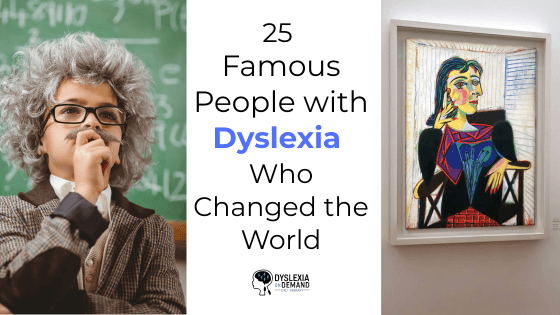
Here are 25 famous people with dyslexia whose lives continue to inspire millions.
Founder of the Virgin Group, Richard Branson is perhaps one of the most recognizable entrepreneurs with dyslexia. He struggled in school, left formal education at sixteen, and built hundreds of businesses spanning airlines, telecommunications, travel, hospitality, and space tourism.
Branson has often shared that dyslexia forced him to simplify ideas, delegate effectively, and focus on the big picture rather than getting lost in details. He credits those habits as major contributors to his success.
For many families, Richard Branson is one of the first examples we share because he demonstrates that reading challenges do not prevent exceptional leadership.
Long before becoming one of the greatest filmmakers in history, Steven Spielberg believed he simply was not smart enough.
He was not diagnosed with dyslexia until adulthood.
As a child, reading aloud was embarrassing, school was exhausting, and he often felt isolated from his classmates.
Instead of giving up, Spielberg poured his imagination into filmmaking. Today he is responsible for classics such as Jaws, E.T., Jurassic Park, Schindler’s List, Saving Private Ryan, and countless other films that have shaped modern cinema.
His story reminds children that a diagnosis does not define their future.
The founder of IKEA struggled significantly with reading and writing throughout his life.
To compensate, Kamprad famously named furniture using places, Swedish towns, lakes, and descriptive words rather than complicated numerical product codes because they were easier for him to remember.
What many people viewed as a challenge eventually helped create one of the most recognizable branding systems in retail history.
His success illustrates how people with dyslexia often design creative solutions instead of accepting obstacles.
Charles Schwab was not diagnosed with dyslexia until adulthood, but throughout school he found reading exceptionally difficult.
Instead of allowing those struggles to define him, he built one of the largest financial services companies in the world.
Schwab has spoken openly about hiring people who think differently because innovation often comes from diverse perspectives rather than identical ways of processing information.
The founder of FUBU and longtime investor on Shark Tank has discussed how dyslexia challenged him in school but strengthened his ability to think creatively and solve business problems.
Daymond John often encourages young entrepreneurs with learning differences to embrace the unique perspective they bring rather than trying to think exactly like everyone else.
David Neeleman, founder of JetBlue Airways and several international airlines, openly credits dyslexia for helping him think creatively.
He has explained that while details may require additional support, innovation and seeing opportunities come naturally.
His career demonstrates that successful leadership often depends more on vision than perfect reading skills.
Former CEO of Cisco Systems, John Chambers has described dyslexia as one of the reasons he approaches leadership differently.
Rather than seeing only today’s challenges, he focuses on identifying future opportunities and long-term solutions.
Many leadership experts believe this type of big-picture thinking is common among highly successful entrepreneurs with dyslexia.
Generations know Henry Winkler as “The Fonz,” but few realize how difficult school was for him.
Before understanding he had dyslexia, teachers often assumed he was lazy or not trying hard enough.
Later in life, Winkler became an outspoken advocate for children with dyslexia and even co-authored the popular Hank Zipzer children’s book series featuring a student with dyslexia.
His advocacy has helped countless children realize they are not alone.
Academy Award-winning actress and television personality Whoopi Goldberg has spoken publicly about struggling with reading as a child.
She has encouraged families to recognize that intelligence comes in many forms and that learning differences should never define a person’s potential.
Award-winning actress Keira Knightley was diagnosed with dyslexia at a young age.
With intensive support from her family and teachers, she learned strategies that allowed her to overcome many reading challenges while pursuing her dream of acting.
She often credits early intervention and determination for helping her succeed.
Before starring in films such as The Lord of the Rings and Pirates of the Caribbean, Orlando Bloom struggled academically because of dyslexia.
His mother encouraged him to focus on his strengths while continuing to work through his reading difficulties.
Today he frequently reminds young people that learning differences do not limit ambition.
Jennifer Aniston has shared that discovering she had dyslexia helped explain many of the struggles she experienced growing up.
Receiving the diagnosis changed the way she viewed herself and brought relief after years of believing she simply was not as capable as her peers.
Her story highlights the emotional impact that an accurate diagnosis can have.
Actor Tom Holland has spoken about the importance of understanding that every brain learns differently.
Although he experienced learning challenges, he pursued his passion with determination and became one of Hollywood’s most recognizable actors.
For children who dream of performing, his story is another reminder that dyslexia does not prevent extraordinary achievement.
Many historians believe Muhammad Ali demonstrated characteristics associated with dyslexia and experienced significant reading difficulties throughout his education.
Although academics were challenging, his unmatched confidence, perseverance, and strategic thinking helped make him one of the greatest athletes in history.
His story reminds us that intelligence extends far beyond reading ability.
Basketball legend Magic Johnson has openly discussed his learning challenges and the importance of surrounding himself with strong mentors and teammates.
His remarkable career on and off the basketball court demonstrates leadership, resilience, and business success that extends far beyond sports.
Hall of Fame pitcher Nolan Ryan reportedly experienced reading difficulties consistent with dyslexia during childhood.
His legendary work ethic, discipline, and persistence became defining characteristics throughout one of the greatest careers in baseball history.
For young athletes with dyslexia, his story reinforces that academic challenges do not determine athletic potential.
Millions of children know Dav Pilkey as the creator of the Captain Underpants and Dog Man series.
Ironically, Pilkey struggled with both dyslexia and ADHD throughout school. Teachers often viewed him as disruptive, and he frequently found himself sitting in the hallway during class.
Instead of giving up, he spent those moments drawing and creating stories.
Today, his books have helped countless reluctant readers discover a love of reading while showing children that creativity can flourish despite learning differences.
Award-winning children’s author Patricia Polacco did not learn to read fluently until she was fourteen years old.
A caring teacher recognized her intelligence and helped unlock her ability to read.
Polacco has since written more than one hundred beloved children’s books, many of which celebrate learning differences and the power of believing in children.
Her story reminds parents just how life-changing one knowledgeable educator can be.
Best-selling author John Irving struggled with dyslexia throughout childhood before becoming one of America’s most respected novelists.
His success demonstrates an important truth that surprises many families.
Having dyslexia does not mean someone cannot become an excellent writer.
It simply means they may take a different path to get there.
While historians cannot diagnose individuals retrospectively with certainty, many scholars believe Pablo Picasso demonstrated characteristics consistent with dyslexia.
His extraordinary visual thinking and ability to see the world differently transformed modern art forever.
Whether or not dyslexia contributed directly to his artistic genius, Picasso represents the type of visual-spatial thinking many researchers associate with dyslexic brains.
Singer and actress Cher has spoken publicly about having dyslexia and the frustrations she experienced in school.
Rather than allowing academic struggles to stop her, she built an iconic career spanning music, television, film, and business.
Her perseverance continues to inspire young people who worry that learning differently limits their dreams.
Journalist Anderson Cooper has discussed living with dyslexia and the strategies he developed to succeed in school and throughout his journalism career.
His story reminds students that communication extends far beyond reading quickly.
Listening, asking thoughtful questions, and connecting with people are equally valuable skills.
Many historians believe Winston Churchill displayed characteristics associated with dyslexia.
Although formal diagnoses did not exist during his childhood, he struggled academically before becoming one of history’s most influential political leaders and one of the twentieth century’s greatest communicators.
His story reminds us that early school performance rarely predicts lifelong leadership.
Academy Award-winning actress Octavia Spencer has shared that she experienced learning challenges growing up.
Her determination, resilience, and commitment to her craft helped her build an extraordinary career in Hollywood despite obstacles along the way.
Although historians continue to debate whether Walt Disney had dyslexia, many experts have noted characteristics consistent with dyslexic thinking, particularly his remarkable visual imagination, storytelling abilities, and innovation.
While we cannot confirm a diagnosis, Disney’s story illustrates the tremendous value of imagination and creative thinking.
Former NFL quarterback and Heisman Trophy winner Tim Tebow has spoken about overcoming learning challenges and emphasizes perseverance, discipline, and hard work.
Whether on the football field or through his philanthropic work, his story encourages young people to focus on character just as much as achievement.
When you look beyond their professions, several patterns begin to emerge.
Very few describe school as easy.
Many experienced frustration, embarrassment, or self-doubt as children.
Nearly all found mentors who believed in them.
Most discovered areas where their natural strengths could shine.
Almost all learned that success depends on much more than reading ability.
Research continues to suggest that many individuals with dyslexia excel at recognizing patterns, thinking creatively, solving complex problems, imagining possibilities, and connecting ideas that others overlook.
Combined with resilience developed through overcoming challenges, these qualities can become powerful advantages throughout adulthood.
Again, these strengths are not universal. Every individual with dyslexia is unique.
But they remind us that intelligence comes in many forms.
One of the greatest gifts you can give a newly diagnosed child is perspective.
Children naturally compare themselves to classmates who seem to read effortlessly.
Without guidance, they may begin to believe that struggling to read means they are not smart.
Nothing could be further from the truth.
When we introduce children to famous successful people with dyslexia, we are not suggesting they need to become the next Richard Branson or Steven Spielberg.
We are helping them understand something much more important.
Successful adults once sat where they are sitting today.
Many struggled through reading groups.
Many dreaded reading aloud.
Many wondered if they would ever catch up.
With the right instruction, encouragement, and support, they found their path.
Your child can too.
The goal is not to compare your child to someone famous.
The goal is to remind them that their future has not been written yet.
If your child has recently been diagnosed with dyslexia, remember this.
Dyslexia explains why reading may be difficult.
It does not define intelligence.
It does not predict future success.
It does not limit creativity.
It does not prevent leadership.
Most importantly, it does not determine what your child can become.
With evidence-based structured literacy instruction, knowledgeable educators, supportive parents, and plenty of encouragement, children with dyslexia can become confident readers while continuing to develop the unique strengths that make them who they are.
Perhaps years from now, another child receiving a new diagnosis will look up to someone whose story has not yet been written.
Perhaps that story will belong to your child.
American Psychiatric Association. (2022). Diagnostic and Statistical Manual of Mental Disorders (5th ed., text rev.).
Eide, B. L., & Eide, F. F. (2011). The Dyslexic Advantage: Unlocking the Hidden Potential of the Dyslexic Brain. Hudson Street Press.
International Dyslexia Association. Dyslexia Fact Sheets and Research Library.
Made By Dyslexia. Research and Dyslexic Thinking resources.
Shaywitz, S. (2020). Overcoming Dyslexia (2nd ed.). Alfred A. Knopf.
Taylor, H., & Vestergaard, M. D. (2022). The Complementary Cognition hypothesis of dyslexia. Frontiers in Psychology.
Wolf, M. (2018). Reader, Come Home: The Reading Brain in a Digital World. Harper.
Yale Center for Dyslexia & Creativity. Dyslexia research and educational resources.
Megan Pinchback, MBA, LDT, CALT is the founder of Dyslexia On Demand, a virtual dyslexia therapy practice serving students across the United States and internationally. As a Licensed Dyslexia Therapist and Certified Academic Language Therapist, Megan has dedicated her career to helping children with dyslexia develop strong reading skills while building confidence and self-advocacy. Through Dyslexia On Demand, the “Don’t Call On Me” podcast, parent education, and national speaking engagements, she equips families with evidence-based information, practical strategies, and hopes that every child can become a successful reader and learner.

©2026 Dyslexia On Demand. All Rights Reserved.