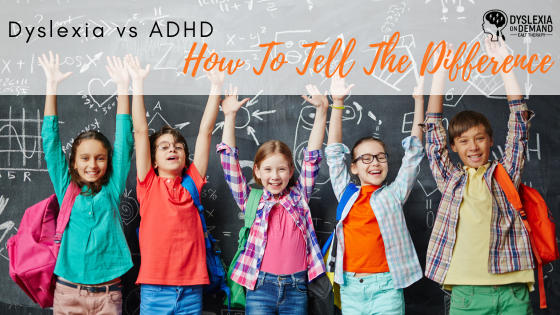
Dyslexia vs ADHD: How to Tell the Difference
Executive Summary
Dyslexia and ADHD share several overlapping symptoms, making it easy for parents to confuse the two, especially when reading and classroom performance become challenging. This post explains the key differences between the conditions, highlights how they can co-occur, and outlines the next steps for seeking a comprehensive evaluation and appropriate intervention.
From the time they are born—and even in the months before they’re born—we get inundated with all kinds of information on how to raise our children. There are books, websites, blogs, well-meaning relatives, and even classes for parents to learn all about parenting. But it’s not until you are actually doing the work in real life, that you’re really getting to know your child. The best text to follow for how to parent your child is—well—your child. Children are full of wonder and awe, and they can teach parents so much.
Right around school age is when some parents might notice that their children are exhibiting behaviors that aren’t typical. Sometimes it’s delayed speech development, pronunciation problems, impulsivity, or excessive talking. Parents may worry that their child has difficulty reading or problems with paying attention. If your child is exhibiting symptoms that make you wonder about a possible learning disability, it’s important to speak to trained experts who can help you to get an official diagnosis. Quite often, symptoms of different conditions may overlap. Read on to learn more about dyslexia vs ADHD and how to tell the difference.
ADHD and Dyslexia: It’s completely understandable why ADHD and dyslexia are so often talked about together. In fact, they don’t just overlap in how they show up in the classroom — they frequently co-occur. Research commonly cites comorbidity rates around 30 percent, but in practice the overlap appears much higher. Many families see signs of both at the same time, and it can be genuinely difficult to tease apart which traits are tied to attention challenges and which are tied to reading difficulties.
This is a big reason the two can feel like a “chicken or the egg” situation. They influence each other, they mask each other, and they can make the identification process more complex. Still, with thorough norm-referenced testing and a trained eye, it is possible to distinguish what’s what and create a clear path forward for support.
While ADHD and dyslexia are distinct conditions, their high rate of comorbidity is a central theme — and one that deserves to be front and center. Families should know that it’s extremely common for these two to “hang out” together, and that navigating both is absolutely possible with the right guidance and evaluation tools.
Some similarities: In a classroom setting, both ADHD and dyslexia might present in a student who is experiencing the following: academic underachievement, difficulty with executive function, slow work speed, inaccuracy of school work, and low self-esteem. When sustained attention and sharp literacy skills are required, functioning in a classroom can be difficult for students with ADHD and dyslexia. Experiencing repeated frustration in the classroom can lead to issues with anxiety and avoidance behaviors in class as well.
Discover the differences: While there is some overlap for ADHD and dyslexia, there are some distinct differences. ADHD is a deficit primarily in attention, executive control, and impulsivity; dyslexia is neurobiological in nature, and it’s a deficit in language processing.
- When it comes to reading difficulties, kids with ADHD may struggle with rushing through and not paying close attention, while kids with dyslexia exhibit a distinct inability to decode words. They have trouble reading fluently and accurately.
- To get more detailed: a student with ADHD may make reading errors due to impulsivity and careless mistakes, while a student with dyslexia makes phonological errors like omitting small words or reversing letters.
- While a child with ADHD might show inconsistent effort across areas like homework, school work, and chores, they may be able to hyper-focus on things they love to do. For a child with dyslexia, they may struggle with sitting down to read and write, but prefer to do sustained tasks they enjoy like listening to an audiobook or building something out of blocks.
- When it comes to spoken language, both children with ADHD and children with dyslexia may be incredibly articulate, expressive and creative speakers. Many dyslexic kids in particular show strong verbal abilities and impressive oral storytelling skills — strengths that often stand in contrast to their challenges with print. That said, some children with dyslexia can experience early speech delays and word-finding difficulties, while some children with ADHD may show rapid, impulsive or tangential speech.
Interventions for these conditions: Typically, ADHD students respond well to behavioral management such as taking frequent breaks and introducing novelty. Sometimes, medication can be an option for people with ADHD. For dyslexia, remediation is usually required to help with the decoding deficit that is present. This can be done through a structured literacy program that is Orton-Gillingham based, like Dyslexia on Demand.
Co-occurrence is a thing: Sometimes, these are common comorbidities—though they are still distinctly different conditions.
Consider your next step: The best step to take if you suspect that your child may have ADHD or dyslexia is to pursue a comprehensive psychoeducational evaluation. These professionals can test for ADHD and dyslexia, and then you can figure out the best kind of treatment for your child.
Dyslexia therapy remains a tried and true method: No matter what your diagnosis is, every child should grow to be responsible, independent, and an advocate for their learning success. If you do discover that your child is dyslexic, Dyslexia on Demand can help. It is our mission to make dyslexia therapy accessible to students who need it. Our online programs help to change lives and improve self-confidence. Our Certified Academic Language Therapists (CALTs) are highly trained experts who help to administer the highest quality of individualized instruction. Sessions with Dyslexia on Demand provide therapy to students, and they also provide parents with strategies to help their students succeed.
Are you ready to learn more? Start a conversation with the experts at Dyslexia on Demand. Get in touch with us to find out more or to book a free consultation on our website.
FAQs
- Can a child have both ADHD and dyslexia at the same time?
Yes. ADHD and dyslexia frequently co-occur, but they remain distinct conditions with different underlying causes and intervention needs. - How can I tell whether my child’s reading challenges are caused by ADHD or dyslexia?
Children with ADHD may make reading errors due to impulsivity or inattention, while children with dyslexia struggle with decoding, phonological processing, and reading accuracy even when they are focused. - What is the first step if I suspect my child has ADHD, dyslexia, or both?
A comprehensive psychoeducational or neuropsychological evaluation by trained professionals is the best way to determine the presence of ADHD, dyslexia, or co-occurring conditions and to guide next steps for support or therapy.
References
American Psychiatric Association. (2013). Diagnostic and statistical manual of mental disorders (5th ed.).
International Dyslexia Association. (2023). Dyslexia basics. https://dyslexiaida.org
Shaywitz, S. (2003). Overcoming dyslexia: A new and complete science-based program for reading problems at any level. Alfred A. Knopf.
Related Posts