
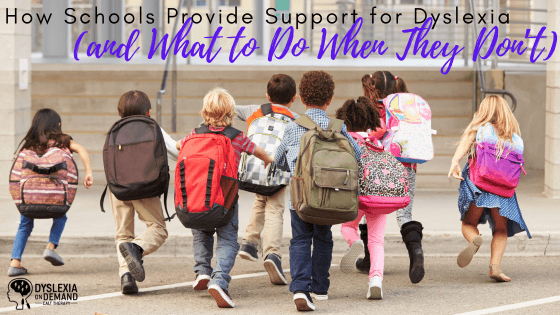
Schools are required by law to support students with dyslexia, but the type and quality of services can vary widely by state, district and campus. Understanding your child’s rights under federal and state law helps families advocate effectively and seek outside dyslexia therapy when school-based support is not enough.
If you have a school-aged child who has been diagnosed with dyslexia, you have just become their very first advocate. Getting the right kind of dyslexia intervention is crucial for your child—especially in the early years when they’re first learning to read. One good thing you have going for you as you face dyslexia: there are laws in place that are meant to help support your student in public school.
Navigating these laws and your child’s educational experience in the classroom can be complex. Even with support from teachers and school staff, it’s likely that you’ll also need to seek some help outside of the classroom. Read on to learn more about how schools provide support for dyslexia (and what to do when they don’t).
Learn about the laws. In the legal sense, dyslexia is usually covered under the term “specific learning disability” when it comes to federal education laws. There are three main education laws that you will want to familiarize yourself with:
Also known as IDEA, this law ensures that eligible students with disabilities are entitled to a free appropriate public education (FAPE). This education should be tailored to each student’s individual needs in what is known as the LRE – the least restrictive environment. Students with dyslexia who are found eligible under IDEA should receive an IEP, an individualized education program. IEPs are legal documents that outline learning goals, services, and school accommodations for a student.
504 is more specifically section 504 of the Rehabilitation Act of 1973. This civil rights law prohibits discrimination based on a student’s disability in any program that receives federal funds. For your student with dyslexia—if he or she does not have an IEP but still needs accommodations—a 504 plan can be put into place. This plan lays out accommodations such as the use of audiobooks or the allowance of extra time. Unlike an IEP, Section 504 does not require schools to provide specialized instruction or educational intervention services. Its purpose is to ensure equal access to the learning environment, not to remediate the underlying learning disability.
This act—signed into law in 1990—was meant to prohibit discrimination against people with disabilities. Overall, the ADA provides civil rights protection, aiming to ensure that students with dyslexia have access to and reasonable accommodations in their school setting. Closely aligned with the protections outlined in Section 504, the ADA extends the principle of equal access beyond K–12 education and into higher education, the workplace, and public life. For students with dyslexia, the ADA ensures continued protection through reasonable accommodations in colleges, universities, and other postsecondary settings. While it does not mandate instructional intervention, the ADA safeguards access and prohibits discriminatory practices, forming the legal foundation that supports students with disabilities well beyond their school years.
In addition to federal protections, many states have enacted their own laws addressing dyslexia. These statutes often focus on screening, identification, educator training, and, in some cases, required interventions. Because education law is implemented at the state level, the scope and strength of these protections can vary widely. It is important to understand that state legislation cannot provide fewer protections than those guaranteed under federal law, including IDEA. States may only build upon or expand federal requirements, though the consistency and quality of implementation can vary and are often debated in practice.
Just like state legislation, even though education for students with dyslexia is protected by laws, the practices that schools implement may vary. Here are some forms of support that may be available to you:
Many schools implement a tiered system of support that can provide varied levels of instruction to dyslexic students. These are sometimes called Response to Intervention (RTI) models, and they can include small group or individualized instruction for reading.
Students with dyslexia may get to have certain accommodations for things like testing. This might include the use of extended time for assignments and tests, assistive technology such as text-to-speech or speech-to-text programs, and digital or audio book use. Other accommodations your student might get could be preferential seating in the classroom—like a seat closer to the front of the room and guided notes or copies of notes from lectures or lessons. These can all be helpful supports for students who deal with the challenges of dyslexia in the classroom each day.
While some schools may offer one-on-one reading instruction, these services are often limited by staffing shortages and a lack of trained specialists. Availability can vary significantly from district to district, making it essential for families to research not only what services a school can provide, but also the quality and appropriateness of those offerings for students with dyslexia. Not all tutoring or reading support is designed to address dyslexia specifically, so understanding the instructional approach being used is critical.
This is where Dyslexia on Demand comes in. While schools are required to provide an appropriate education to all students, they may not use the best kind of dyslexia curriculum like the Orton-Gillingham based programs used by Dyslexia on Demand. If your child needs more intensive instruction for reading, Dyslexia on Demand offers convenient, accessible dyslexia therapy sessions. These programs use research-based Orton-Gillingham curricula that are implemented by highly trained Certified Academic Language Therapists (CALTs).
What Dyslexia on Demand offers through specialized therapy sessions:
At Dyslexia on Demand, our mission is not just based on academic success. Our goal is to have our dyslexia therapy programs change the lives of children who struggle with reading. Reach out to us to learn more about dyslexia therapy or to book a free consultation call.
What services are schools required to provide for students with dyslexia?
Public schools must provide appropriate support under federal law, which may include an IEP, a 504 plan, accommodations or reading intervention depending on the student’s eligibility and needs.
What is the difference between an IEP and a 504 plan for dyslexia?
An IEP provides specialized instruction and services for students who qualify under IDEA, while a 504 plan offers accommodations for students who do not need specialized instruction but still require support to access learning.
What should parents do if school support for dyslexia is limited or ineffective?
Parents can request evaluations, review state dyslexia laws and seek supplemental instruction through specialized dyslexia therapy programs that use research-based approaches such as Orton-Gillingham.
Americans with Disabilities Act of 1990, 42 U.S.C. § 12101 et seq. (1990). https://www.ada.gov
Individuals with Disabilities Education Act, 20 U.S.C. § 1400 et seq. (2004). U.S. Department of Education. https://sites.ed.gov/idea
International Dyslexia Association. (2017). Dyslexia in the classroom: What every teacher needs to know. https://dyslexiaida.org
National Center for Learning Disabilities. (2023). Understanding dyslexia in the public school system. https://www.ncld.org
Rehabilitation Act of 1973, Section 504, 29 U.S.C. § 794. (1973). U.S. Department of Health and Human Services. https://www.hhs.gov


©2026 Dyslexia On Demand. All Rights Reserved.