

When your child receives a dyslexia diagnosis, it can feel daunting. There is a great deal to learn, and while it helps to seek expert support for your child, you can become part of the solution too. The more you understand about dyslexia, the better you can advocate for your child’s needs and offer real understanding and encouragement. That support matters, because a parent who understands what their child is working on can offer the reinforcement that builds motivation and confidence.
One of the simplest places to start is with the language. Dyslexia comes with a lot of specialized terms, and they surface everywhere: in evaluations, in school meetings, and in conversations with therapists and tutors. This glossary explains the terms parents encounter most often, grouped so you can find what you need.
Several different professionals support students with dyslexia, and the terms for them are easy to confuse. Here is what each one means.
Tutoring is a form of instruction that addresses some of the learning challenges children with dyslexia face. Dyslexia tutoring is typically done one-on-one or in a small group, with a tutor helping students develop reading, writing, and language skills.
Therapy is a more intensive approach for students with dyslexia. Dyslexia therapy at Dyslexia On Demand is delivered by Certified Academic Language Therapists, the most highly trained dyslexia professionals, who guide students through a specially designed curriculum one-on-one or in small groups. Rather than addressing surface symptoms, dyslexia therapy helps build the neural pathways that allow a child to process written language more automatically over time.
A Certified Academic Language Therapist, or CALT, holds one of the highest credentials in the field of dyslexia intervention. Earning it requires a master’s degree, extensive specialized coursework, and 700 supervised clinical hours, followed by a national certification exam. A CALT is trained not just to deliver a reading program but to adapt instruction to how each individual child’s brain learns. Every therapist at Dyslexia On Demand is a CALT.
An educational therapist is a professional who helps students with learning challenges by tailoring instruction to how each student learns best. The term is broad and covers a range of training and specialties. You can read more about what an educational therapist does and how the role differs from tutoring in our full guide.
Dyslexia primarily affects how the brain works with the sounds and structure of language. These terms come up often once you start reading about how children learn to read and where dyslexia creates difficulty.
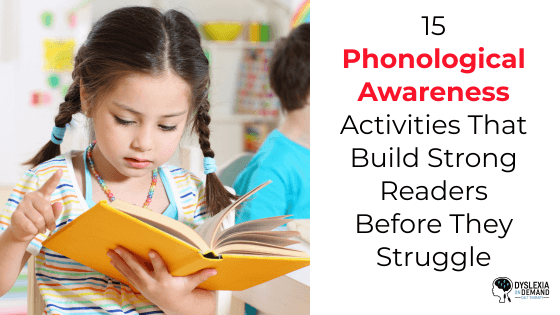
Phonological awareness is the ability to hear and work with the sounds in spoken language, such as recognizing rhymes, breaking words into syllables, and identifying individual sounds. It is one of the strongest predictors of reading success, and there are simple activities that build these skills at home.
Phonemic awareness is a specific part of phonological awareness. It focuses on a student’s ability to notice and manipulate the individual sounds, called phonemes, in spoken words.
Phonemes are the smallest units of sound in spoken language. They combine to form syllables and words. The word cat, for example, contains three phonemes.
Morphology is the study of the smallest units of meaning in language, called morphemes. Prefixes, suffixes, and root words are all morphemes, and understanding them helps students read, spell, and work out the meaning of longer words.
Orthography is the spelling system of a language: the way sounds are represented by letters and letter patterns in writing. Strong readers gradually learn how English orthography works, which supports both reading and spelling.
Decoding is the ability to break a written word into its sounds and blend them together to read it. It is a foundational reading skill, and difficulty with decoding is one of the clearest signs of dyslexia.
Fluency is the ability to read aloud smoothly and accurately at a comfortable pace, with appropriate expression. Fluent reading frees up mental energy for understanding what the text means.
Automaticity is the point at which a skill becomes so practiced that it happens without conscious effort. When word recognition becomes automatic, a reader no longer has to sound out familiar words and can focus fully on meaning.
Comprehension is the ability to understand the meaning of what is read. It is the ultimate goal of reading, and it becomes much easier once decoding and fluency are strong enough that the reader is not spending all their effort on the words themselves.
Orthographic mapping is the process by which the brain stores written words for instant recognition, connecting their sounds, letters, and meaning. It is how readers build a large bank of words they recognize on sight, and it is central to how the brain learns to read.
These terms describe how reading is taught to students with dyslexia. The most effective approaches share a common set of principles, and knowing them helps parents recognize quality instruction when they see it.
Structured literacy is an approach to teaching reading that is explicit, systematic, and cumulative, covering the sounds of language, how those sounds map to letters, spelling, and meaning. It is the approach research consistently shows works best for students with dyslexia, and it sits at the heart of the science of reading.
Multisensory structured language instruction engages several senses at once, including sight, sound, movement, and touch. By connecting to words physically, visually, and audibly, students build a stronger foundation in language skills. Dyslexia therapists integrate visual, auditory, and motor processing alongside direct teaching of the structure of the English language.
Explicit instruction is clear, direct, systematic teaching of reading and writing skills. Nothing is left for the student to guess or figure out on their own; each concept is taught directly.
Systematic instruction follows a specific, logical sequence, with each new skill building on what the student has already learned. It is a core part of explicit instruction.
Orton-Gillingham is the foundational approach behind most structured literacy instruction. Dr. Samuel Orton, a neuropsychiatrist, and Anna Gillingham, an educator and psychologist, developed it in the 1930s. Their method combines direct, multisensory teaching with systematic, sequential lessons and a strong focus on phonics. Orton-Gillingham is an umbrella term for a multisensory approach to structured literacy rather than a single specific program, and you can learn more about how the Orton-Gillingham approach works and why it is so effective.
Take Flight is a comprehensive, two-year curriculum for students with dyslexia, created by the staff of the Luke Waites Center for Dyslexia and Learning Disorders at the Texas Scottish Rite Hospital for Children. It is designed to be delivered by a CALT and is recommended for children ages seven and older. Take Flight helps students achieve and maintain better word recognition, fluency, and comprehension, and it supports the transition from a therapy setting to everyday reading.
Basic Language Skills Therapy is a systematic, intensive dyslexia intervention with a sequential, comprehensive framework. It provides instruction in phonemic awareness, letter recognition, decoding, spelling, fluency, comprehension, handwriting, vocabulary, and written expression.
These are the terms parents encounter most in evaluations, school meetings, and support plans. Knowing them makes those conversations far easier to navigate.
A specific learning disability is a formal category that describes difficulty with specific academic skills such as reading, writing, or math, despite adequate instruction and ability in other areas. Dyslexia is classified as a specific learning disability, which is the language schools and evaluators use when determining eligibility for support.
A psychoeducational evaluation is a comprehensive assessment that looks at how a child learns, using a set of standardized tests covering reading, language, memory, and cognitive skills. It is how dyslexia is formally identified, and our guide explains what a full evaluation involves and who is qualified to carry one out.
Rapid automatized naming measures how quickly a child can name a series of familiar items, such as letters, numbers, or colors. It appears in most dyslexia evaluations because slow naming speed is a common feature of dyslexia and relates to reading fluency.
Accommodations and interventions are changes made to support a student with dyslexia. Accommodations adjust how a student accesses learning, such as extra time, assistive technology, or preferential seating. Interventions are the targeted instruction that builds the underlying skills. The two work together and serve different purposes.
An IEP (Individualized Education Program) and a 504 Plan are the two main ways schools provide support. An IEP includes specialized instruction with measurable goals and progress monitoring, while a 504 Plan provides accommodations that remove barriers. Our guide covers which accommodations to ask for and when.
Assistive technology is any tool that helps a student work around a specific barrier. For students with dyslexia, this often means text-to-speech software that reads text aloud, or speech-to-text tools that let a student dictate instead of writing by hand.

©2026 Dyslexia On Demand. All Rights Reserved.