
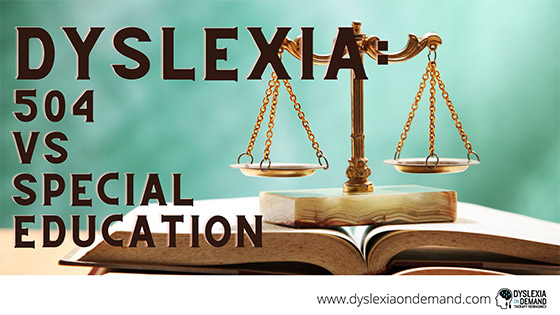
For many reasons, parents need to understand what “umbrella of responsibility” they want their child’s dyslexia diagnosis to be managed under. In many states and school districts this is not a consistent policy, but it is a difference that can have huge implications for your family. It is also not a choice that it appears parents can make. Families are not presented with a menu of options for how and where the school will handle dyslexia evaluation, intervention, and management.
I am here to tell you there is one route you want to take your child down, and that is the Special Education route. Why should dyslexia be covered under Special Education and not 504? Because of your rights and your child’s rights, that is why. Unlike many dyslexia-specific state laws, both Special Education and 504 are federal laws, so regardless of what state you live in, this discussion applies to you.
For many of you, I need to back up and explain the difference between Special Education and 504.
I will go under the assumption that we all broadly know what Special Education is. But there are two important points I have to make. The first is that Special Education is nothing to fear. For those of us who are 40 or older, Special Ed is no longer the “short bus,” with children isolated in their own wing of the school where every disability from Down syndrome to learning disabilities was housed in the same classroom. I hate to speak so bluntly, because this stigma was created by a foul mishandling of students once upon a time. But the concern exists for far too many parents I speak with daily. When your child is served under Special Education, there is no enormous visual difference between their programming and that of students in General Education. Instead, students are mainstreamed and receive the specialized attention and support they need to reach their true potential.
The second important point is that all students under the Special Education umbrella are protected under a wonderful statute called the Individuals with Disabilities Education Act (IDEA), which dates back to 1975. The short version is that IDEA is a law that makes a free appropriate public education available to all children with disabilities. It is centered on parent rights, which was Congress’s intent with this law. It dictates that parents should be legally involved in decisions about their child with a disability in public school. After all, you are the person who knows your child best.
Some children with special needs do not receive services under IDEA but are instead served under Section 504 of the Rehabilitation Act of 1973. Section 504, a civil rights law, prohibits discrimination on the basis of disabling conditions by programs and activities receiving or benefiting from federal financial assistance.
The way I often describe who falls under the 504 umbrella is all students who have “hidden disabilities” that do not impact their intelligence: ADD or ADHD, where they struggle with the focus needed to absorb classroom learning; a chronic illness such as diabetes or Tourette’s syndrome, where they must miss more school; or a learning disability, where they struggle to fully demonstrate their knowledge. Some characterize it more as a condition where the child has a physical or mental impairment but their learning itself is not impaired. We want to be able to protect all of these children’s civil rights, right?
See how it becomes a little grey for many kids? See how we really could argue many situations into both categories? Is it a disability, or is it a hidden condition? It is a blurry line that I bet a great lawyer could argue both ways.
Let’s consider this for dyslexia. On one hand, dyslexia is technically a Specific Learning Disability, where there is an unexplained gap between a child’s intellectual ability and their performance. On the other hand, many districts manage it as one of these “hidden ailments,” saying the child’s intelligence is intact but they just cannot demonstrate their learning adequately.
This is the part of the blog where I could go on and on about all the specific differences between the two laws, but that is largely beside the point, because we are here to talk about what is proven to be the best course of action for giving children and parents the most rights. That is the most important thing to focus on right now.
The main difference between whether your child’s dyslexia is covered under Section 504 or Special Education revolves almost entirely around one acronym: IDEA. Remember that Special Education law I mentioned, the one focused mainly on parent rights? Do not just take my word for it. The US Department of Education has taken the same position, and back in 2018 it put several state education agencies under review for not placing dyslexia and a few other disorders under Special Education. I will not name any names, since my own state was one of them. But is it still happening? You bet it is.
Let’s lay out some of the specific parent rights you bypass when you allow the school to take your student down the 504 path:
You say you already tested and qualified for dyslexia under 504? No problem. Go back and request a Full Individual Evaluation (FIE) under Special Education. Under IDEA, once you make that request in writing, the school must respond formally: it either conducts the evaluation or provides you written notice explaining why it declines, which you then have the right to challenge. That is a meaningful protection, because under 504, if the school does not share your concern, it does not have to complete the evaluation at all. Once your child is admitted to Special Education, any decision made for your child will be made with you present in the room.
And isn’t that the way it should be? You made this amazing person, and you carry responsibility for them under the law. You care about that child more than anyone in the school district, and you will always know what is best for them and be their loudest advocate. Shouldn’t you be an active part of their educational programming?
If you want help thinking through your child’s support plan, our guides on 504 accommodations by grade level and choosing the right accommodations are a useful next step.
Is dyslexia covered under an IEP or a 504 Plan?
Dyslexia can be covered under either, but they are not equal. A 504 Plan provides accommodations, while an IEP under IDEA provides specialized instruction, enforceable goals, and stronger parent rights. For most students with dyslexia, the IEP route offers more protection and more meaningful support.
What is the difference between an IEP and a 504 Plan?
An IEP is a legally enforceable plan under IDEA that spells out specialized instruction, measurable goals, and the exact services a child will receive. A 504 Plan is a civil rights protection that provides accommodations to remove barriers, but it does not require specialized instruction or the same procedural safeguards.
Can a school refuse to evaluate my child for special education?
A school can decline an evaluation request, but under IDEA it must give you prior written notice explaining why, and you have the right to challenge that decision. This is different from a 504 Plan, where the school is not obligated to evaluate if it does not share your concern.
My child already has a 504 Plan. Can I still request an IEP?
Yes. Having a 504 Plan does not prevent you from requesting a Full Individual Evaluation under special education. You can make that request in writing at any time, and the school must respond formally rather than simply ignore it.
Why do some schools place dyslexia under 504 instead of special education?
Some districts treat dyslexia as a “hidden condition” that does not impair intelligence, which routes it toward 504. Others recognize it as a Specific Learning Disability under IDEA. The classification affects your rights significantly, which is why it is worth understanding before you agree to a plan.
Does the type of plan really affect my rights as a parent?
Yes, substantially. Under IDEA you have the right to be present at meetings, to help make decisions, to federally mandated timelines, and to disagree and seek an independent evaluation. A 504 Plan does not carry the same procedural protections, so the plan your child is placed under shapes how much say you have.


©2026 Dyslexia On Demand. All Rights Reserved.